
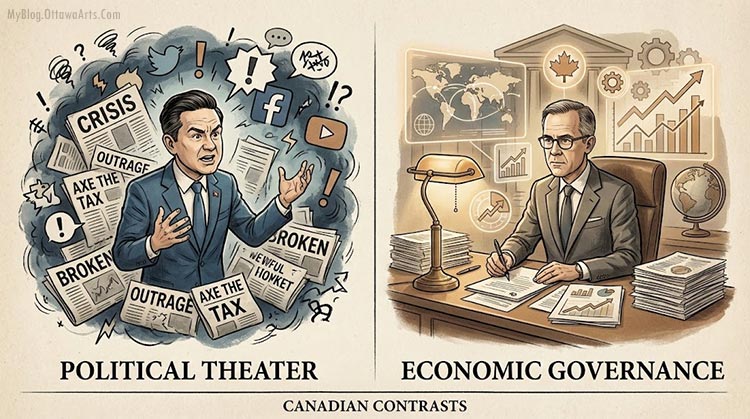
Mark Carney leads Canada with realistic economic and trade policies, while Pierre Poilievre relies on social media theatrics and performative politics.
There appear to be two Canadas running in parallel these days, and the contrast is sharp indeed.
One is led by people who appear to understand that a country is not a mood, a meme, or a marketing funnel. It is a system—messy, slow, and bounded by physics, capital, diplomacy, and law. It requires patience, incentives, trust-building, and a willingness to absorb criticism while doing work that rarely produces instant applause.
The other Canada is being marketed by Pierre Poilievre and the modern Conservative Party, and it seems to thrive almost entirely in the negative spaces that exist between facts. It is a Canada where outrage substitutes for planning, where insinuation replaces evidence, and where every complex problem is flattened into a villain-of-the-week narrative engineered for maximum emotional yield.
These are not merely stylistic differences. They are fundamentally incompatible theories of governance.
Mark Carney governs as if reality is real. Poilievre campaigns as if it is optional.
It appears as though that distinction now defines Canadian politics more than ideology, region, or even policy preference.
Carney’s government operates under a deeply unfashionable assumption: that markets respond to predictability, that allies respond to seriousness, and that long-term economic resilience is built through incremental, often unsexy decisions rather than theatrical confrontation. It is a worldview shaped by numbers, balance sheets, and institutional memory. It assumes that capital is skittish, that supply chains are geopolitical, and that credibility—once squandered—is brutally expensive to recover.
Poilievre’s Conservatives have chosen a different path. They have opted for permanent agitation. Their strategy is not to present an alternate governing framework, but to delegitimize the very idea of governance itself. Parliament becomes a prop. Motions are drafted not to succeed, but to fail loudly. Language is harvested selectively from agreements they oppose, stripped of context, and redeployed as proof of betrayal. The objective is not policy change; it is narrative dominance.
This is politics optimized for social media virality, not national stewardship.
The Conservative leader’s signature move has become the promotion of things that do not yet exist—projects, approvals, obstacles—followed by furious denunciations when those fictional constructs fail to materialize on schedule. Pipelines are invoked as metaphors rather than infrastructure. Permits are demanded for proposals that have not been proposed. The absence of substance is reframed as obstruction by enemies who are always conveniently abstract.
It is governance by hallucination.
Carney, meanwhile, is doing what serious economic managers do: quietly stacking fundamentals.
Under his leadership, Canada has become a magnet for capital precisely because it does not behave like a country in the grip of a political identity crisis. Major industrial investments are landing not because of bombast, but because tax structures, energy costs, and regulatory clarity make sense. Trade diversification is being pursued not as a slogan, but as a strategic hedge against geopolitical volatility. Procurement reform is being executed with an unapologetic preference for domestic capability, strengthening Canadian firms without chest-thumping nationalism.
None of this photographs well.
None of it can be reduced to a chant.
That is exactly why it matters.
Poilievre has bet his political future on convincing Canadians that all of this is either fake, corrupt, or irrelevant. His party’s communications strategy treats good news as suspect by definition and bad news as divinely revealed dictum. Economic data is dismissed as propaganda. Foreign engagement is framed as weakness. Institutional competence is portrayed as elitism. The underlying message is consistent: if it didn’t happen on his feed, it didn’t happen at all. Or, it did, bit it was bad for Canada—always bad… because reasons.
This is not skepticism. It is epistemic vandalism.
The Conservative Party once prided itself on fiscal seriousness, institutional respect, and an understanding that markets punish chaos. That party no longer seems to exist in any meaningful sense. What remains is a movement addicted to grievance, hostile to nuance, and increasingly contemptuous of the very mechanisms that allow a modern economy to function.
Poilievre’s populism is not the rough-edged prairie kind that once challenged complacent elites while still respecting reality. It is imported, algorithmically optimized, and deeply unserious. It borrows its aesthetic from jurisdictions where governance has collapsed into performance art and then pretends that imitation is authenticity.
Carney, by contrast, does not pretend that governing is fun.
His approach to economic management reflects an understanding that Canada’s advantages—energy abundance, political stability, skilled labor, institutional continuity—must be protected from the corrosive effects of performative politics. He engages with foreign leaders not to posture, but to align incentives. He treats trade as a strategic instrument, not a cultural battlefield. He understands that immigration policy is an economic lever as much as a social one, and adjusts it accordingly rather than using it as a cudgel.
This is what adult leadership looks like.
It does not promise miracles. It promises work.
The Conservative response to this seriousness has been to declare it illegitimate. Poilievre frames competence as conspiracy, compromise as cowardice, and expertise as corruption. His party’s rhetoric increasingly mirrors the logic of movements that cannot tolerate complexity because complexity exposes their emptiness.
When outcomes improve, the goalposts move. When investments arrive, motives are questioned. When employment rises, the data is impugned. There is no condition under which reality is allowed to validate the government’s approach, because validation would collapse the narrative of permanent crisis on which Conservative mobilization depends.
This is why Poilievre’s attacks often feel strangely disconnected from material conditions. They are not designed to persuade skeptics; they are designed to energize a base that has been trained to experience politics as a constant state of emotional emergency.
Carney is simply not playing that game.
He governs as if the job is to stabilize the system, not inflame it. His administration has leaned into long-term investments in technology, energy, and defense capacity not because they score points, but because they anchor sovereignty. It has pursued regional trade relationships with the quiet confidence of a country that knows it must not be overly dependent on any single partner. It has made policy choices that recognize Canada’s structural realities rather than denying them for applause.
That refusal to indulge unreality is precisely what infuriates Poilievre.
You cannot out-rage a man who won’t rage back. You cannot bait a technocrat into a culture war without exposing your own unseriousness. So the Conservative strategy has shifted toward delegitimization: if the work cannot be discredited, the institutions doing it must be.
This is dangerous territory.
Once a political movement commits to eroding trust in every mediating structure—statistics agencies, civil service, trade institutions, regulatory bodies—it forfeits the right to claim it wants to govern. What it wants is control without constraint. Power without responsibility. Authority without accountability.
Canada has seen where that road leads elsewhere.
Carney’s value lies not in perfection, but in orientation. He governs facing forward, toward outcomes, rather than backward toward grievances. He understands that economic sovereignty in the twenty-first century is built through coordination, not tantrums. He is treating Canada as a participant in the global system, not a victim of it.
Poilievre treats Canada as a prop in his own political drama. It’s not about Canada—it’s just about defeating the opposition.
The difference could not be clearer.
One man is doing the unglamorous work of making a country function in a volatile world. The other is auditioning for an audience trained to confuse volume with leadership. One accepts the burden of reality. The other monetizes its rejection.
History has never been kind to the latter.
Countries that thrive do so because, at critical moments, they choose seriousness over spectacle—not as a moral posture, but as an act of self-preservation. They recognize that governance is not performance art and that the applause of the moment is a poor substitute for structural stability. They choose governance over grievance because grievance is infinitely renewable and good governance is exhausting but effective. It requires trade-offs, delayed gratification, and the political courage to accept that many correct decisions will feel unsatisfying, technocratic, or even unpopular when first made. Serious countries internalize this tension rather than fleeing from it.
They also choose leaders who understand that the job is not to be liked, nor to dominate the emotional temperature of the room, but to be right often enough, for long enough, that institutions remain intact and outcomes compound. These leaders accept criticism as an occupational hazard, not a personal insult. They measure success in years rather than news cycles, and they understand that credibility—economic, diplomatic, and institutional—is accumulated slowly and lost quickly.
Canada, for now, has made that choice. It has resisted the temptation to replace competence with catharsis, and administration with agitation and theater.
Whether it continues to do so will depend on whether voters can still distinguish between the country that exists—the one governed by constraints, incentives, and consequence—and the one that gets screamed about online, where complexity is treated as treason and reality itself is framed as optional.
Because one of them is real.
And the other is just noise.
Further Reading:
- Prime Minister Carney secures new trade and investment agreements with the UAE
- Reuters: Bank of Canada holds rates, notes economic resilience
- Carney deepens trade and economic partnerships at the G20 Summit
- FT: Canada launches major human capital initiative
- Carney builds trade ties with Singapore and ASEAN
- Politico: Carney’s Liberals near majority after Conservative defection
- Major investments and resilience measures for Canadian industries


