
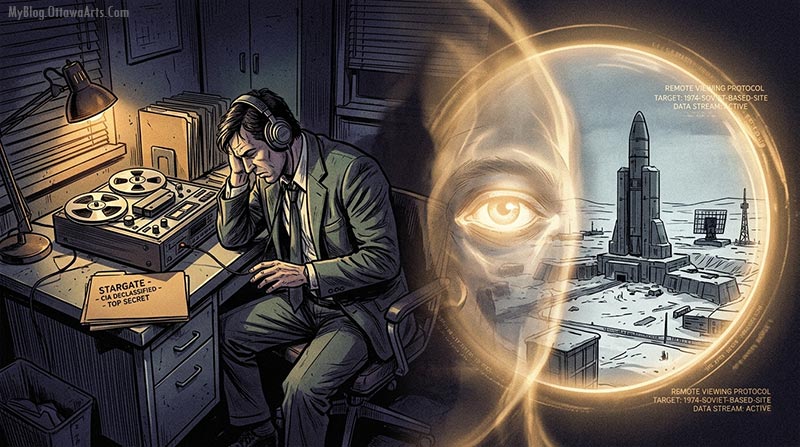
You know what I love? I love the idea that somewhere in the bowels of the Pentagon, a bunch of men with crew cuts and four‑digit security clearances sat around a table in 1975 and said, with absolutely straight faces: “You know what this country needs? Psychics.”
I’m serious. This happened. The United States government—the same people who can’t manage to audit their own budget, the same people who gave us the Bay of Pigs and the TSA—spent upwards of twenty million dollars trying to train hippies to spy on the Soviet Union using nothing but their minds. They called it Project Stargate. And here’s the part that should keep you up at night: for a while, a bunch of very serious, very credentialed people thought it was working.
Now, most mainstream accounts treat this as a punchline. Government wastes money on woo‑woo. Ha ha. But I want to ask you a different question. What if they were right? What if—and I’m just putting this out there—the reason they kept the program running for twenty years wasn’t just bureaucratic stupidity? What if, buried in those classified files, there was something that actually looked, to an open‑minded observer, like genuine evidence of human consciousness doing things we’ve been told are impossible?
I can hear people out there becoming confused. But it was debunked! The CIA said it was worthless! Yeah. The CIA also said the Iraq War was a good idea. The CIA also said LSD was a mind‑control weapon. The CIA, my friends, is not exactly the gold standard for intellectual honesty. So maybe—just maybe—we ought to take a second look at the story they’ve been selling us?
The Same Shit, Bright, Shiny New Shovel? Or Something Actually Interesting?
Let’s start with what actually happened. Project Stargate (it had other names too—Sun Streak, Grill Flame—the Pentagon has a gift for naming things like a teenage boy naming his first Dungeons & Dragons character) was a classified program that ran from 1972 to 1995. Its goal: to determine whether remote viewing—the ability to perceive distant locations using nothing but the mind—could be used for intelligence gathering.
Here’s the setup. It’s the height of the Cold War. The Soviets are supposedly pouring resources into “psychotronics”—ESP, telepathy, the kind of thing you’d expect to see in a 1970s sci‑fi movie. The American intelligence community, being nothing if not predictable, decides it needs its own psychic arsenal. So they round up a motley collection of physicists, parapsychologists, and retired military officers, and they give them a mission: find a way to use remote viewing—the alleged ability to perceive distant places without leaving your chair—to spy on the Russkies.
The people running it weren’t idiots. Dr. Harold Puthoff was a laser physicist with a Stanford doctorate. Russell Targ was a laser physicist too. They ran rigorous, double‑blind experiments. They published in peer‑reviewed journals. They brought in skeptics to try to poke holes in their results. And here’s the thing that never makes it into the snarky documentaries: the results were consistently, stubbornly above chance.
One of their early subjects was a man named Pat Price, a former police commissioner. In one experiment, he was given geographical coordinates for a site he’d never heard of. He described, in detail, a Soviet weapons facility in the Ural Mountains—including a giant gantry crane that, as satellite photos later confirmed, was exactly where he said it would be. The CIA was so impressed they brought him in as a full‑time “remote viewer.”
Now, you can explain this away. Maybe he got lucky. Maybe the intelligence community inadvertently fed him information. Maybe the descriptions were vague enough to be retrofitted to satellite photos. And maybe—just maybe—there’s something here that our current materialist worldview can’t explain, and instead of investigating it with an open mind, we’ve been conditioned to laugh it off because the New York Times told us it was nonsense.
The Smart‑Idiot Framework, Applied to the People Who Shut It Down
The people who killed Project Stargate weren’t hard‑nosed empiricists. They were bureaucrats—and worse, they were bureaucrats with a vested interest in maintaining the status quo.
Let me explain.
You have a program that suggests human consciousness might be non‑local. That telepathy, clairvoyance, maybe even psychokinesis might be real. What does that do to the military‑industrial complex? It undermines the whole edifice. If you can get intelligence by having someone sit in a chair in Maryland, you don’t need spy satellites. You don’t need drones. You don’t need the trillion‑dollar black budget that funds everything from the F‑35 to the CIA’s private air force. The Pentagon isn’t going to let a bunch of psychic hippies kill any of its beloved cash cows.
So what do they do? They wait until a skeptical researcher and former professional magician, once performing under the name “The Merry Mystic”, Ray Hyman—who was funded by the CIA—writes a report saying the program’s results were “too unreliable.” They brief the media on the failures, not the successes. They declassify selectively. And then they let the public believe that the whole thing was a boondoggle, a footnote in the history of government waste, a cautionary tale about the dangers of letting academics play spy.
But here’s the thing that should make you furious. The research didn’t stop. The evidence didn’t go away. The results—the statistically significant, double‑blind, peer‑reviewed results—are still there, buried in the archives of the Stanford Research Institute, waiting for someone with the courage to ask the one question the Pentagon has spent fifty years trying to suppress: What if this is real?
We’ve talked before about how the most effective conspiracies aren’t the ones with shadowy figures—they’re the ones where we collectively agree to look away.
The Parable of the Garden and the Lawnmower
Let me tell you a story.
Imagine you’re a gardener. You spend your whole life tending a small patch of earth. You know every inch of it. You know what grows, what doesn’t, what the soil needs. One day, someone hands you a seed and says, “This will grow into a tree that reaches the clouds.” You plant it. It sprouts. It grows faster than anything you’ve ever seen. It’s not behaving like any plant you know. And that terrifies you.
Now, what do you do? Do you nurture it? Do you study it? Do you try to understand it? Or do you get out the lawnmower and cut it down to the roots, because a tree that tall would change everything about how you garden—and you’re comfortable with the way things are?
That’s Project Stargate. The seed was a genuine anomaly—something that didn’t fit the materialist worldview that has dominated science for a hundred years. And instead of nurturing it, the people in power cut it down. Not because it didn’t work. Because if it did work, it would threaten every institution built on the assumption that consciousness is just a by‑product of brain chemistry, that the universe is a machine, that human beings are just complicated meat puppets with no connection to anything beyond themselves.
Same shit, bright new shovel? No. This is the opposite. This is a case where the shovel might have actually been made of something genuine, and they buried it because they didn’t want to admit that their entire worldview—the one that justifies war, exploitation, and environmental destruction—rests on a lie.
The same impulse that turns science into a religion—that tells us to trust the algorithm, trust the data, trust the institution—is what makes us so willing to dismiss anything that doesn’t fit the approved worldview
From Cold War Paranoia to Human Potential
Here’s where the politics come in. On one hand, the counterculture—the same people who gave us the anti‑war movement, feminism, environmentalism—was deeply interested in consciousness expansion, altered states, the boundaries of human potential. That was the world that produced Project Stargate’s early researchers. They weren’t Cold Warriors. They were genuine seekers who thought they’d found something that could change the world.
On the other hand, the government co‑opted their research for the worst possible purposes. Instead of asking, “How can this help us understand consciousness, heal trauma, expand human freedom?” they asked, “How can this help us spy on the Soviets?” They took something potentially beautiful and turned it into another weapon of empire. And when it didn’t serve that purpose neatly enough, they killed it and mocked anyone who still believed.
That’s the tragedy. Not that the government wasted money on psychics. But that the government got its hands on something that could have helped humanity break free from its destructive patterns—and instead, it used it for espionage, then abandoned it, then made sure the public would never take it seriously again.
The Question Nobody Wants to Ask
So here’s my question. Actually, I have two.
My first question is for the CIA, the Pentagon, and every bureaucrat who signed off on burying this research: What were you afraid of? Because you don’t spend twenty years on a program, and you don’t classify the results for another twenty after that, unless somewhere in those files there’s something that you don’t want the public to see. And I’m not talking about psychic spies. I’m talking about evidence that consciousness is real—not just real, but powerful. Evidence that the things we’ve been told are impossible might actually be possible. Evidence that the human mind is not a closed system, but something that reaches out and touches the world in ways we’re only beginning to understand.
My second question is for you. Why are you not demanding the full files be released?
Because here’s the thing. The same government that told you psychics were a joke is the same government that told you WMDs were in Iraq, that told you the banks were too big to fail, that told you the surveillance state was for your protection. They have a vested interest in you believing that human beings are limited, that our potential has been reached, that the only way forward is to trust the institutions that have spent the last fifty years lying to you.
But what if they’re wrong? What if the psychics were on to something? What if the real conspiracy isn’t the one the government was investigating—it’s the one they’ve been running ever since, to make sure you never find out what they discovered?
Sound far‑fetched? It shouldn’t. We’ve seen this before—a court, a king, a system that will do anything to keep its secrets, including rewriting history.
The Mystery We’re Supposed to Forget
The real mystery here isn’t whether remote viewing works. The real mystery is why a phenomenon that produced decades of statistically significant results in controlled scientific experiments is treated as a joke by the same institutions that funded it. The real mystery is why the government would spend twenty years on something they now claim never worked—and why they won’t release the full archives so the rest of us can judge for ourselves.
I’m not saying I know the answer. I’m not even saying I’m convinced. But I am saying this: the people who tell you with absolute certainty that human consciousness is limited to the inside of your skull, that the universe is just dead matter bouncing around, that the only reality is the one you can measure with machines—those people have a lot to lose if they’re wrong.
And they’ve been working very, very hard to make sure you never find out.
Think about it. The same shit, bright, shiny new shovel? Or just another story the Pentagon never wanted you to read?
Further Reading:
- CIA Reading Room (Star Gate Collection) – Direct access to the declassified files—memoranda, status reports, and the 1995 American Institutes for Research review that officially terminated the program. The collection includes the final response to Congress and raw documents from the Stanford Research Institute experiments.
- Remote Viewing: A 1974–2022 Systematic Review and Meta-Analysis – The first comprehensive meta-analysis of remote viewing studies spanning nearly 50 years. It reports a strong average effect size with no signs of publication bias, concluding that remote viewing protocols are the most efficient among extrasensory perception research methods.
- Outside the Gates of Science: Why It’s Time for the Paranormal to Come in from the Cold – A serious but accessible examination of parapsychology’s intersection with quantum physics and evolutionary biology. Broderick interviewed the scientific director of the Star Gate program and makes a compelling case that psi phenomena deserve mainstream scientific attention.


