
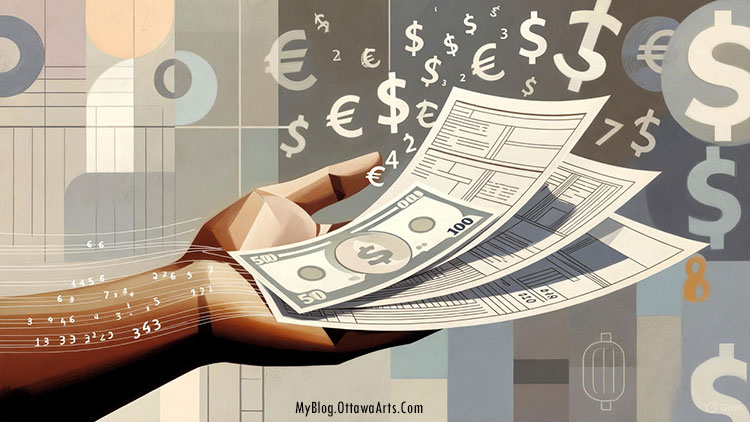
THE DEBT WE CARRY IN OUR POCKETS
(An Inquiry into Why Money May Not Belong to You at All)
There are times—usually late at night, usually under the faint hum of a refrigerator or the flickering sodium lamps along an empty street—when a person can hold a banknote in his hand and feel something uncanny about it. It is only paper, after all: cotton fibers, polymer strips, a printed insignia of some grand civic bird of prey. But it sits there with the mute stubbornness of a riddle, as though the paper itself is just a shadow cast by something larger and more inscrutable. You stare at the number—10, 20, 50—printed with the bureaucratic indifference of a state that will outlive every hand that ever passed it along, and wonder: What exactly am I holding? Is this mine, truly mine, or is this merely a sliver of some national hallucination?
This is the question we’re going to pursue—not as a matter of ideology, not as some dreary political sermon, but as a bare-knuckled wrestling match with verifiable facts, historical records, and the economic machinery humming behind the walls.
The argument is simple to state and harder to believe:
Money, in any modern economy, does not actually belong to the people who claim to own it. It belongs to the government. What individuals “hold” is not wealth but a temporary token—a placeholder—indicating the amount of government debt currently in their possession.
This is a bold claim. It is also, as we’ll see, increasingly difficult to refute once one strips the problem down to its bones.
But before charging into the coliseum of economic theory, it’s worth pausing a moment to consider the strange theatricality of money itself. There’s a roughneck tang to the thing—the way a banknote accumulates the sweat of bartenders and the perfume of strangers, the way it sails along the undercurrents of a city like some dirty, persistent spirit. There’s also a fragility—the thinness of the paper, the microscopic flowers of ink, the quiet deceitfulness of its calm little numerals. Both perspectives are useful, because both circle one truth: money is an artifact of human imagination, backed not by nature but by decree.
And that decree, as we will argue, is the decree of the state.
The Government’s Name Is Written All Over Your Money—Literally and Legally
Let’s begin with the simplest, most verifiable fact possible. In virtually every developed nation on Earth, physical currency is explicitly defined in law as property issued by the state, not private merchants, not private citizens.
In the United States, every banknote printed today carries the declaration:
“Federal Reserve Note”
The Federal Reserve, in turn, is a creature of Congress—created by the Federal Reserve Act of 1913—and every note is, in black-letter accounting terms, a liability of the Federal Reserve System.
This is not speculative. It is stated plainly on the balance sheets published by the Fed itself—tables anyone can download from the Federal Reserve’s official website. Under “Liabilities,” one finds “Federal Reserve Notes Outstanding.” That is, the cash in your wallet appears not under Assets, where property normally resides, but under Liabilities—where debts live.
Canada, similarly, prints banknotes that are liabilities of the Bank of Canada, a Crown corporation owned by the federal government. The European Central Bank lists circulating euro banknotes as liabilities. The Bank of England does the same. One can verify all of this with tedious ease by checking their annual reports.
So the first factual stone in our foundation is this:
All modern physical currency is a legally defined liability of a central bank. In accounting terms, when you “own” cash, the issuing authority “owes” something to you.
But what, exactly, does the government owe you? Gold? Silver? A bushel of wheat? A claim on a plot of land? No. The government owes you only one thing:
It owes you the ability to use that currency to extinguish your tax obligations.
This is the part people routinely miss, because it is too embarrassingly simple:
Money is the thing you must use to pay taxes.
And this fact alone gives it value. Remove taxes, and the currency becomes as meaningful as theatre tickets to a show no longer playing.
Money Has Value Because the State Declares It the Only Ticket for Escaping Taxation
The “State Theory of Money”—sometimes called Chartalism—was articulated more than a century ago by the German economist Georg Friedrich Knapp. His core idea can be summarized in one crisp sentence:
Money derives its value from the state’s power to impose and enforce taxes.
Modern Monetary Theory (MMT), a contemporary school of economic thought taught in major universities and cited by policymakers, adopts this principle as a foundational truth. You don’t need to take their word for it. You don’t need to adopt their prescriptions. You only need to observe the mechanics of every functioning national currency.
Here is how the system works, on a factual, mechanistic level:
- The government imposes taxes on its citizens.
- The government declares that these taxes must be paid in the national currency.
- Citizens must acquire that currency to avoid legal penalties.
- Therefore, citizens will work, trade, and accept the currency because everyone needs it to settle their tax debts.
This motivation is coldly practical. Its truth is observable in every non-barter society for which we have historical documentation. People accept currency because the state demands it back through taxation. That is the engine behind the illusion.
From this, a second stone falls into place:
If the government stopped enforcing taxes, the demand for currency would evaporate almost instantly, because its only guaranteed use would vanish.
And so the logic turns itself inside out:
- You accept money not because it has value.
- It has value because the state demands you return it to them.
This begins to sound very much like the government owns the money, and you are merely holding a redeemable chip.
A Banknote Is a Receipt, a Claim, a Placeholder—But Not Property in the Deep Sense
Let us pause for a moment and examine the nature of a receipt—say, a coat-check stub. You hand your coat to the clerk; he hands you a ticket. That ticket is not the coat itself. It is not even ownership of the coat. It is a claim, a placeholder, which entitles you to retrieve something at a later time.
This metaphor is imperfect but illustrative.
A dollar bill is the inverse of a coat-check stub. It is not a claim for something from the government—it is the government’s claim upon you. It tells the tax collector, “This individual has delivered one dollar’s worth of accepted economic activity. Let it be subtracted from his tax burden.”
And because every citizen is under that burden—because taxation is not optional—the currency gains the gravity of necessity.
The great irony is that people believe currency is a “store of value.” In truth:
Currency is a store of tax-avoidance potential.
It is simply the thing you can use to eliminate the obligation the state has imposed upon you.
The Government Can Create or Destroy Money at Will—Which Private Owners Cannot Do
This is where the mood deepens. Because while citizens cradle their wallets like talismans of independence, the government treats currency with a casual omnipotence that would embarrass the gods of Olympus.
This, too, is not rhetoric—it is empirical fact:
- The government can create new currency units in unlimited quantities through its central bank and treasury operations.
- The government can invalidate or withdraw currency (as India did in 2016, or as the U.S. did with large-denomination notes).
- The government can freeze accounts, seize funds, or repossess currency involved in criminal actions.
- The government sets the legal definition of currency: what counts, what no longer counts, and what will count tomorrow.
If you “owned” money the way you own your shoes, none of this would be possible. But you do not own it in that sense. Instead:
Holding money is akin to temporarily acting as the custodian of a government-issued token whose rules, lifespan, and quantity are controlled entirely by the issuing authority.
A government cannot arbitrarily seize your bicycle, because your bicycle is your property.
But it can seize your money.
It can tax your money.
It can invalidate your money.
It can print so much of the same money that your portion becomes diluted.
This asymmetry is the sort that exposes the illusion: If the government truly owns nothing, then why is everything denominated in terms of the government’s units?
Why, indeed.
Currency Circulation Is a Loop—A Cycle of Government Debt Returning to Its Source
To understand why money is better understood not as property but as government debt, we need to examine the life cycle of currency.
First, as a matter of empirical record:
- Every central bank lists currency in circulation as a liability.
- A liability, in accounting terms, is something owed.
- Therefore, currency is something the government owes.
But how can a government owe anything to the people who supposedly “own” the currency?
The answer is elegant and devastating:
The government owes you the ability to use that currency to settle your tax obligations.
Once you use money to pay taxes, the government cancels it out—literally cancels it, as in subtracts it from the liability side of its balance sheet.
Money, therefore, is not wealth—it is a circulating IOU from the government, a piece of evidence that the government owes a particular quantum of tax-forgiveness to the holder.
When you spend it, you transfer that tax-forgiveness to someone else.
When you save it, you simply defer the use of that tax-forgiveness to the future.
When the government taxes it back from you, the IOU is returned and destroyed.
This loop is not a metaphor. It is the basic operational model of every central bank in existence today.
And if the government and its legal apparatus are the original issuer of the IOU, and if the government is the only authority that can redeem or cancel the IOU, then logically and legally:
The IOU belongs to the issuer, not to the temporary holder.
This is how debt works. If you lend a book to a friend, the friend holds it for a while, but the book remains your property. When it comes back, it returns to its source.
So too with currency.
You don’t own the IOU.
You just hold it until it goes home.
Money Is Not a Commodity. It Is a Language the State Teaches You to Speak.
People often imagine money as a thing—a shiny, concrete, graspable object: the jingle of coins, the crisp bookish scent of a hundred-dollar bill. But in truth, the physical form is a theatrical prop. Money is a system of measurements, like centimeters or minutes, and those measurements are administered by the state.
This is not philosophical abstraction—it is historical and legal reality.
Consider:
- A dollar is not a piece of paper.
- A dollar is a unit of account, defined in statutes and enforced by courts.
- A balance in a bank account is not “stored value”—it is a number in the government-regulated banking system reflecting your temporary claim on extinguishing tax obligations.
The government defines the unit.
The government enforces the meaning of the unit.
The government is the exclusive arbiter of what extinguishes tax obligations.
If you invented your own currency, the state would not accept it for taxes. Therefore, your homemade money would possess no mandatory demand, and thus no guaranteed value.
This is the final nail in the coffin of the “private money” myth. Money is not a natural resource like gold. It is a linguistic artifact—a system of quantification underwritten by law.
And because the state owns the language, it owns the terms of exchange.
Which means, ultimately:
The government owns the money. You operate within its grammar.
Further Reading:
- What Is the Composition of Central Bank Balance Sheets in Normal Times? — overview by the Federal Reserve Bank of New York showing currency and reserves as liabilities.
- Fiat Money — encyclopedic overview of how fiat money works: its defining legal‑decree status rather than commodity backing.
- Modern Monetary Theory — explanation of how monetary instruments issued by government operate as liabilities, and how money originates as state debt.
- Money and Banking – Part 2: Central bank balance sheet and immediate implications — analysis of how banknotes are recorded as liabilities of the central bank.
- What Is a Central Bank? — foundational description of a central bank’s role in controlling currency issuance and monetary policy.
- What Is Fiat Money? (from Bankrate) — accessible discussion of fiat currency’s pros and cons, including how value derives from government decree


