
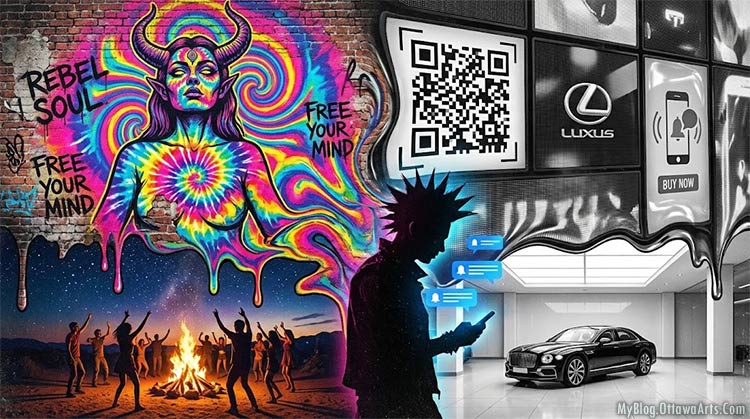
There’s a special kind of rot that sets in when a culture forgets what it was rebelling against in the first place. It starts quietly—like a faint humming behind the drywall—then swells into a grotesque chorus of corporate slogans disguised as human feeling. What was once a howl against the machine becomes the jingle for it. You can smell it in the air, metallic and sweet, like overheated circuitry dipped in corn syrup. Counterculture has been taxidermied, stuffed with polyester fiber, fitted with tiny LED eyes, and propped up in the gift shop where it can be purchased in three convenient sizes. Rebellion has become a SKU number.
This is the grand enshitification of counterculture: the long, greedy digestion of our weirdest, wildest, most defiant impulses until the only thing left is a beige residue suitable for mass consumption. It’s not new, but it’s accelerating—an accelerant poured on the last embers of anything that once felt like a genuine affront to the status quo. The transformation is always the same: first they fear it, then they mock it, then they market it, then they forget it ever meant anything else.
And the cruel joke is that it works every time.
The Slow-Motion Hijacking of the Human Spirit
Picture a warehouse in any major city. Concrete floors. Rented lighting rigs. A team of brand consultants wearing identical sneakers and ironic T-shirts purchased pre-distressed for authenticity. They’re hunched over a whiteboard brainstorming slogans like “Experience Authenticity™!” or “Unleash Your Inner Maverick!” These phrases are test-marketed siren songs engineered for the consumer yearning—desperate, starved—for even the simulation of freedom.
This is where counterculture goes to die—not in the streets, not in the clubs, not in the desert under a thundering sky, but in boardrooms lit by cold LEDs where rebellion is portioned into micro-targeted ad campaigns. The autopsy is quiet. No eulogies. Just quarterly projections. (See how subcultures like hipsters have historically been “defanged, skinned and consumed” by consumer culture.)
Every era of rebellion gets embalmed eventually. The psychedelic movement that once pulsed with visions of collective transcendence has been stripped for parts, turned into pastel tie-dye kits sold at big box stores and mindfulness apps engineered to soothe the very anxiety created by the tech platforms selling them. Punk rock, born of rage and alienation, is now an aesthetic: fishnet tights in the mall, a designer leather jacket that costs more than a used car, and a playlist on a streaming service whose parent corporation donates to the political forces punk originally despised. Graffiti, once illegal breath on the city’s underbelly, now exists in curated “street art districts” with QR codes providing “artist statements” optimized for Instagram stories.
Even tattoos—once a defiant mark of outsider status—have become the terrain of suburban wine moms who get minimalist line-art of their astrological sign to celebrate a “journey of empowerment” recommended by their wellness influencer of choice.
The sacred becomes stylesheet. The dangerous becomes décor. And the wild becomes cheap, gaudy fucking wallpaper.
From Psychedelic Revelation to Branded Mindfulness
Take psychedelia. Once upon a very real time, people cracked open their skulls with compounds that dissolved the wall between the self and the universe. Regardless of one’s stance on these substances, the historical fact is that they were part of a cultural eruption: a demand to see the world not as an assembly line but as a living organism.
Now? Now psychedelia has been plowed into a commercial monocrop. Mushrooms have become logo-fodder for energy drinks and sweatpants printed with cartoonish spores promising “vibes.” Meditation—once a practice meant to confront the swirling chaos of the mind—has calcified into subscription-based apps offering audio clips recorded in rented studios by voice actors who have never meditated a day in their lives. Breathwork, once the domain of monks and madmen, is being repackaged as a perk included with premium coworking memberships.
Nothing is so sacred that it can’t be blanched, freeze-dried, and reconstituted as content.
We’re told to “unlock higher consciousness,” but only if we’re willing to watch a 30-second pre-roll advertisement first.
Punk Rock as a Discount Rack Lifestyle
Then there’s punk—the snarling, grease-stained movement that refused to harmonize with anything other than its own discord. Punk was never supposed to be pretty. It was a wound you were meant to look at. It rejected polish on principle. And yet here we are, scrolling past algorithm-approved punk playlists that sterilize the very impulse that created them. Songs once spat into the void by people who had no future are now “motivational audio” for fitness brands.
The safety pins have been smoothed into fashion accessories. Mohawks appear in shampoo ads. Concert venues that once reeked of heat and chaos have been converted into artisanal breweries with curated ambiance. You can now take a guided “punk walking tour” in multiple cities, complete with a laminated map and official merchandise at the end.
Imagine explaining that to someone from the original era. They would choke on their cigarette.
Burning Man, Now With More Burning Capital
And oh, the great desert carnival. What was once a temporary city built on radical self-reliance and spontaneous creativity has become a luxury retreat for venture capitalists seeking vision quests between funding rounds. You can now rent an air-conditioned, wifi-enabled yurt for a sum that could pay someone’s rent for months. There are catered dinners, private chefs, and “brand activations.” The original impulse—to create something ephemeral, unmarketable, untellable—has been buried under a landslide of influencer drone footage.
The phrase “radical inclusion” now comes with velvet ropes.
the whole scene now feels like a fever dream scripted by a deranged marketing department on mescaline. The dust storms that once stripped everyone down to the same skeletal anonymity have been replaced by boutique filtration systems, as if rebellion itself could be vacuum-sealed. The desert has become a showroom floor, a grotesque parody of Dionysian chaos where the gods of commerce ride in on Segways and the shamans wear corporate lanyards. It’s not a carnival anymore—it’s a TED Talk in drag, a Silicon Valley board meeting disguised as pagan ritual. The fire still burns there, but it smells faintly of venture capital. The music pounds, but it’s sponsored by an energy drink. And somewhere in the haze of fruit-flavored vape, the original spirit of feral, unmarketable creation is laughing bitterly, drunk on its own ashes.
When Everything Is “Alternative,” Nothing Is
At some point, the word “alternative” became a tax category. “Indie” became a synonym for “not quite profitable yet.” Subculture became a set of purchasable traits, customizable like a smartphone lock screen. You can mix-and-match rebellion like you’re assembling a bowl at a fast-casual restaurant:
- A dash of bohemian,
- A sprinkle of goth,
- A drizzle of neo-spiritual minimalism,
- Extra authenticity on the side.
It’s all just branding now. Identity as bundle. Passion as product. Rebellion as a subscription tier.
The strange thing is that many of the consumers buying these repackaged fragments genuinely believe they’re touching something real. They’re not wrong to seek meaning—they’re just being deceived by a marketplace skilled at imitating the silhouette of meaning without any of its weight.
It’s a kind of cultural deepfake.
Algorithms: The New High Priests of Cool
The algorithm doesn’t care about rebellion, only engagement. It scavenges the digital ruins of every subculture, extracts the parts that generate clicks, and stitches them together into infinite scrollable homogeneity. It’s a feedback loop so smooth you could butter toast with it.
It sorts you into taste clusters, classifies your yearning, and sells snippets of your personality to advertisers who then chase you across the internet with robotic precision. The algorithm’s job is not to reflect what you want—it’s to train you to want what is easiest to sell.
This is why all creative spaces begin to look the same after enough time online: the same pastel gradients, the same motivational typography, the same surgically sanitized bohemian aesthetic designed for maximum screenshot appeal. It’s rebellion rendered toothless and friendly, the kind of edge you could allow near toddlers.
There’s no danger. No risk. No spittle. No blood. Just cozy, bite-sized dissidence safe enough to eat in the airport lounge.
Art as Brand Collateral
We’ve reached a moment where the line between creative expression and corporate slogan has blurred into a shimmering mirage. Companies now use the language of self-discovery to move product. They talk about “disrupting legacy systems” while shipping identical plastic devices in identical packaging from identical factories. They talk about “authentic living” while designing ecosystems that measure, track, categorize, and monetize every breath their users take.
Meanwhile artists—real ones—fight to survive in a world where attention is the new oxygen. Not because their work lacks value, but because value itself has been redefined as whatever generates the highest click-through rate.
The marketplace has no interest in complexity, contradiction, or the grotesque beauty of unpolished truth. It wants neat narratives and digestible aesthetics. It wants art that behaves itself.
But art that behaves is not art. It’s wallpaper. Cheap, gaudy fucking wallpaper.
The Illusion of Infinite Choice
The great lie of modern consumer culture is that we have infinite choice. In reality, we have infinite variation—not the same thing. Every subculture is merely a branch of the same corporate tree. Whether you pick the hipster branch, the skater branch, the boho branch, or the dark-academic branch, your choices lead back to the same small handful of multinational companies that profit no matter what you think you’re choosing.
This is why the enshitification feels inevitable: the machine has learned how to metabolize everything.
It metabolizes noise.
It metabolizes revolt.
It metabolizes human longing.
The faster culture produces new subversions, the faster they’re captured, rendered harmless, and reissued in pastel packaging. The so-called “freedom of choice” is nothing more than a carnival of mirrors, each reflection leading back to the same cash register. You can swap your thrift-store jacket for a luxury hoodie, your vinyl collection for a streaming subscription, your anarchist zine for a corporate podcast—but the transaction is identical, the profit flows to the same boardrooms. It’s a shell game played with human desire, a Vegas buffet of rebellion where every dish tastes strongly of microplastics. The illusion is infinite, but the architecture is claustrophobic: a labyrinth designed not to liberate you, but to keep you wandering in circles until you collapse from exhaustion, clutching a branded water bottle.
The Last Unwired Territories
But here’s the thing: rebellion doesn’t die because brands steal its clothes. It just mutates. Goes underground. Sheds its skin and grows stranger, sharper, harder to pin down. True counterculture has always thrived in the places where the marketplace cannot follow—not because it’s forbidden, but because it’s uninterested. The moment rebellion becomes profitable, it ceases to be rebellion.
So where does it live now?
Maybe in the places where things still break. Where people still make noise for the sake of noise. In DIY collectives operating out of basements and storage units. In late-night conversations that unravel into near psychotic imaginings of wild conjecture. In art that refuses commodification not because it’s too pure but because it’s too difficult, too feral, too uncooperative to be marketed properly.
Maybe real counterculture looks less like a lifestyle and more like a refusal.
A refusal to optimize.
A refusal to brand oneself.
A refusal to convert every thought into content.
A refusal to package the soul into monetizable fragments.
Rebellion now requires the courage to be unprofitable.
The Final Compromise
The tragedy isn’t that the machine steals from us—it always has. The tragedy is that we willingly participate. We hand over our strangeness, our wildness, our unfiltered impulses because we’re terrified of being invisible. We trade authenticity for audience, originality for algorithmic approval. The marketplace doesn’t need to kill counterculture; it simply waits for us to surrender it voluntarily in exchange for convenience and a quick dopamine hit.
But here’s the hidden truth: you can’t kill the impulse toward the raw, the real, the wild. You can bury it under layers of branding, you can dilute it with sponsored content, you can wrap it in nostalgia and sell it back to the people it once belonged to—but you can’t extinguish it.
Somewhere, someone is making something magnificent and unmarketable. Something that will never go viral, never generate ad revenue, never serve as collateral in a brand partnership. Something that exists solely because making it was necessary to them. That is where counterculture lives now—in the refusal to be monetized.
In the end, the enshitification of counterculture is not a story about defeat. It’s a story about cycles: every rebellion is born feral, grows teeth, gets declawed, and is finally muzzled for corporate display. But new rebellions are always forming in the cracks—raw, unbranded, and unoptimized. …hopefully.
The machine will come for those too, eventually.
And new ones will take their place.
The human spirit is more stubborn than the marketplace.
And far harder to package.


