
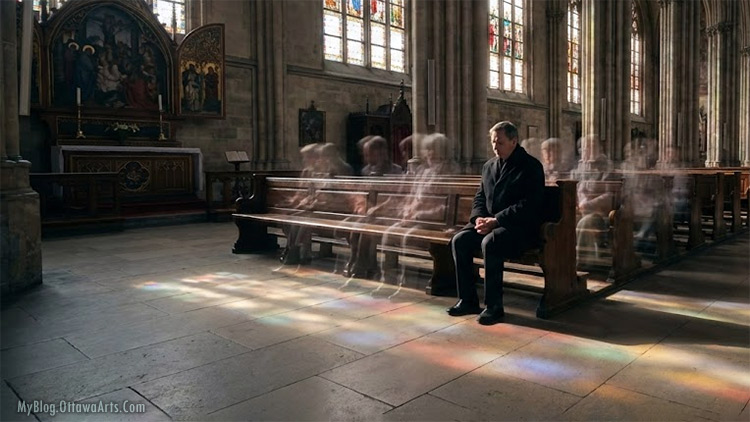
An Op-Ed with More Echoes Than Congregants
There is a particular hush that descends on a Sunday morning—a hush that arrives not from the collective reverence of millions filing into chapels, mosques, synagogues, and strip-mall temples, but from the soft, persistent suspicion that those millions may not exist at all. If you’ve ever woken up at 9:47 a.m., sunlight slanting through the blinds at an angle so pure it feels scripted, and thought, What if none of this is real? What if the entire universe and everything in it is just my own elaborate fever dream? then you, my friend, have entertained the peculiar, shimmering demon called solipsism.
Solipsism, that fine and terrible notion that the self is the only certain reality, is philosophy’s way of letting you be both the messiah and the village idiot without having to change your shoes. It is seductive in the way all ego-magnifying concepts are seductive. Who wouldn’t, at least briefly, enjoy a cosmology in which the entire cast of humanity has been hired—by your imagination, no less—to perform in your own personal theater of experience? There’s a bit of flavorful decadence there: the idea that we live in a novel where every side character exists solely to underline our own shimmering banality. And then, of course, something of a punch: the swaggering possibility that if you’re alone in the universe, you may as well swagger loudly.
But here is the rub: if solipsism is true, if the world is a hologram projected by your own glowing, wet neural apparatus, then why bother dragging your meat-sack illusion of a body to church? Why kneel, why recite, why sing hymns written by the phantasmal ghosts your mind keeps around for dramatic flair? Why give money to a plate passed by a deacon who could dissolve like soap bubbles the moment your attention shifts?
The answer—well, the answers—are both foolish and profound. And like all good Sunday sermons, they come bundled with their own contradictions.
The Case for Staying Home and Worshipping Nothing But the Ceiling Fan
Let’s begin with the obvious argument: if you’re the only real person, the congregation is decorative. The choir is an hallucination with better pitch than you, the minister an orator conjured from your own fondness for narrative cohesion. The toddler who shrieks through the silent prayer is simply your subconscious reminding you that you’re still irritated by children.
What, then, is gained by stepping outside?
Nothing, perhaps. Nothing except the trouble of shoes, sweaters, keys, and the silent accusation of the front door slamming behind you. If the world is only a projection, then church becomes a kind of spiritual screensaver—a ritual your mind performs for itself because it forgets, periodically, that it’s entirely and utterly alone.
There is a certain integrity in staying home. A solipsist who attends church is like an atheist who prays “just in case” or a vegetarian who eats bacon when no one is looking: a person attempting to have it both ways, a person stitching contradictions into their own worldview because the pattern is aesthetically pleasing.
Besides, if solipsism is true, the God you encounter in church—if you encounter anything at all—is merely an avatar of your own mind. Why go to a building to worship something that lives inside your cranium like a well-fed house-cat?
You could worship in bed.
You could worship in the shower.
You could worship not at all.
You could simply lie there, stare at the ceiling fan, and declare, with all the quiet bravado of a prophet in his pajamas, “I am the only being that exists, and therefore I shall rest.”
There is a kind of darkly comic nobility to this position. If no one else exists, then no one can judge you. Not even the imaginary old women in the third pew who smell of lavender and silent disapproval. Not even the pastor whose eyes seem to follow you when you try to sneak out early. They aren’t real. Their judgments are figments. They’re you judging you. And all such figments are equal in the eyes of the only true God: you.
So the case against attending church, for the devout solipsist, is wonderfully simple: why waste time tending to a community made entirely of phantoms?
The Case for Going Anyway—Real or Not
But of course, the universe—your universe—is rarely so tidy. Even if solipsism holds, even if the pews are filled with sophisticated daydreams masquerading as parishioners, there is still value in the ritual.
This is the part solipsists hate: the moment when their philosophy becomes inconveniently warm-blooded.
Start with this: church, as an institution, is not built solely from people (imagined or otherwise). It is a structure of meaning, a container for stories, a set of psychological scaffolds that allow a mind—your mind, if solipsism is correct—to articulate ideas it cannot easily express alone. You might be the sole sovereign of reality, but even sovereigns crave symbolism.
A service, especially a good one, is a sort of cosmic mirror. It reflects your doubts, desires, longings, and fears back at you in language older than your bones. It grants shape to the ineffable. Even if every hymn is sung by figures who evaporate when you close your eyes, the music still reverberates in the cathedral of your skull.
And then there is the Deist twist—the notion that God is real not as personality but as principle, not as a backstage manager but as the original spark, the Author Emeritus of existence. A Deist can be a solipsist and still seek awe. After all, the question “Am I the only one here?” does not necessarily negate the possibility that something greater once set this whole dream in motion. A cosmic architect may have wound up the universe like a pocket watch and walked away, leaving you with the tick-tock echo and a lifetime supply of existential questions.
Church, then, becomes less a gathering of believers and more a weekly appointment with your own curiosity. Even if the parishioners are imaginary, the questions you bring with you are real. The sense of wonder is real. The shiver down your spine during a well-timed moment of silence is real.
If solipsism is true, then you are the custodian of meaning. You must generate your own transcendence. Church—its architecture, its liturgy, its warmth or austerity—may simply be one of the tools your mind built for that purpose.
And there is another pragmatic point: you don’t actually know if solipsism is true. You can suspect, you can imagine, you can philosophize with the swagger of a man who believes the cosmos is his personal dressing room—but you cannot prove. And in the absence of proof, attending church becomes a kind of Pascal’s Wager for the metaphysically self-absorbed.
If solipsism is false, then the people sitting around you are real, startled companions in this strange hall of existence. If solipsism is true, then no harm has been done. You’ve indulged a ritual that enriches the only consciousness that matters: yours.
Besides, even if the congregation is imaginary, they are still better dressed than you would be if you had just stayed in bed.
The Middle Path: Solipsism with Social Graces
Let’s not pretend there is a tidy answer. If there were tidy answers, we would not need philosophy; we would only need pamphlets. But there is a workable middle ground for the solipsist who is neither so arrogant as to dismiss communal rites nor so sentimental as to believe they are literal gatherings of souls.
It is this:
Go to church as if the people around you are real, even if you suspect they may not be.
Not because they are real, but because you are real. And the rituals you participate in—even the ones built out of imagined companions—shape the emotional architecture of your world. A universe of one is still a universe, and it deserves texture. It deserves rhythm. It deserves moments of solemnity and moments of uplift. It deserves, occasionally, the smell of polished wood and old hymnals.
Treating others as real is a way of humbling yourself, even within a worldview that technically makes humility unnecessary. It is choosing grace despite having no metaphysical obligation to exhibit it. It is choosing kindness even if kindness is only an internal monologue.
That choice—made freely, made consciously—carries moral weight. Even in a world populated by phantoms.
In the end, a solipsist going to church may be the purest form of faith. Not faith in God, necessarily, nor in the congregation, nor in the stained-glass saints who gaze down with glassy indifference—but faith in the usefulness of seeking meaning, however constructed.
Faith in the possibility that if you sit quietly in a pew—real or imaginary—and ask a question that holds genuine heat in your chest, something within you will answer.
And if that something is just another part of your own mind?
Well. It’s still answering, isn’t it?
A Sunday Conclusion, Drifting Toward Noon
So: if you’re the only real person, why bother with church?
You shouldn’t—because the world is your invention, religion your puppet show, and the pastor a figment delivering sermons you’ve written for yourself.
You should—because the rituals matter, the questions matter, the search for meaning matters, even in a universe of one.
The solipsist’s Sunday is not a commandment; it is a choice.
A gesture.
A little dance between skepticism and longing.
And perhaps that is the most human thing of all. Even if you’re the only human in existence.
Further Reading:
- Solipsism – Britannica overview of the idea and its philosophical problems.
- Solipsism and the Problem of Other Minds – Internet Encyclopedia of Philosophy article giving a clear account of solipsism’s epistemological depth.
- Why Solipsism is OK – Argues that solipsism is valid, showing it can coexist with ethics, evolution, and other frameworks.
- “The Mezzanine” by Nicholson Baker – A hyper-detailed novella that lives almost entirely inside the narrator’s consciousness—an elegant and humorous exploration of the mind observing itself.


