
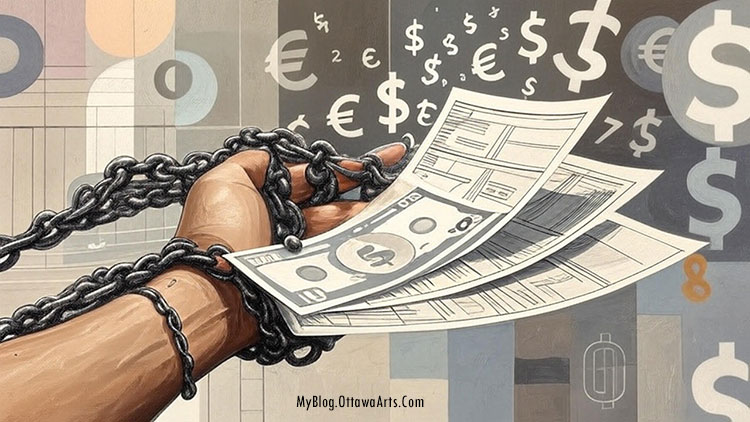
THE DEBT WE DANCE WITH
(How Private Wealth Turns Out Not to Be So Private After All)
If Part I laid the foundation—brick by bone-white brick—then Part II must furnish the house and invite the reader in, even if the thermostat is broken and the lights flicker and there’s a strange hum coming from the basement. Because the deeper we push into the anatomy of money, the more the ordinary citizen discovers he has been living inside a construct that was never truly his. That smiling billfold, that bulging savings account, that inscrutable tangle of numbers glowing from a phone screen at two in the morning—none of it is what it pretends to be. The illusion is pleasant, yes. But illusions often are.
The stories we tell ourselves about who owns what—and why—are never merely stories. They are tools, or weapons, or soft cages with velvet bars. And nowhere is the cage softer, or more invisible, than in the realm of money.
Why Private Property Rights Do Not—and Cannot—Fully Apply to Money
Let us begin with what is legally undeniable in virtually every modern jurisdiction: private property rights are not absolute, especially not with respect to money.
This is not an ideological interpretation. It is spelled out in statutes, regulations, and judicial decisions across the developed world.
1. The State Can Tax Your Money Without It Being “Theft”
This is the simplest and most devastating fact. The government can legally compel you to surrender a portion of your money—annually, monthly, even retroactively—and no court will consider this a violation of private property rights. Why?
Because taxation is a sovereign power, defined as lawful by the very structure of the state.
If your money were truly your property in the deep sense—inalienable, fundamental, immune from unilateral seizure—taxation would be unconstitutional everywhere. But it is not. In every modern nation, the state can take your money without negotiation. It takes it because the state defines the money.
This asymmetry is profound and, once recognized, impossible to ignore. Your money is not your property—it doesn’t belong to you. It’s a token of liability held by the State. It is not your property.
The State Can Invalidate Your Money
Governments have, throughout history, declared certain banknotes invalid:
- India’s 2016 demonetization of the ₹500 and ₹1,000 notes.
- The U.S. discontinuation of the $10,000, $5,000, $1,000, and $500 bills in 1969.
- The European Central Bank’s discontinuation of the €500 note in 2016 (withdrawing new issuance and encouraging phaseout).
In each case, ordinary people were suddenly holding rectangles of paper that no longer served as currency. If money were truly private property—on a par with land or tools or artwork—the state would have no power to simply declare it null.
But it does.
And it does so because the notes belong to the issuer.
3. Civil asset forfeiture, account freezes, and seizure authority
Governments can freeze your bank accounts, seize your funds during criminal investigations, and confiscate assets associated with illegal activities. The legal systems of the U.S., Canada, EU member states, the U.K., Australia, and others all include such powers.
Your bicycle is not subject to spontaneous invalidation, but your money is.
Your house cannot be nullified, but your savings can be frozen.
Once again: the state treats your money as something it ultimately controls. Because, of course, ultimately, it does.
Bank Deposits Are Not “Money You Own”—They Are IOUs You Hold
The next layer of the onion is more pungent, and more revealing.
When people say, “I have $5,000 in the bank,” they imagine that the money is there, sitting like a well-trained dog in a vault. But the reality is utterly different:
A bank deposit is not money. It is a promise. A liability. A digital IOU.
This is not financial esoterica; it is foundational banking law.
Let’s examine the facts that any citizen can verify through a central bank’s public explanations:
Banks do not “store” your money—they owe it to you
When you deposit money into a bank:
- You cease owning the money.
- The bank becomes the owner of those funds.
- The bank simultaneously owes you an equivalent amount, payable on demand.
This is codified in banking law across almost every developed nation. Bank deposits appear on the bank’s balance sheet as liabilities, not assets. The bank’s assets are the loans it issued and the investments it controls—not your deposit.
This alone should give pause. Because if your “money” is not a thing you own but a claim someone else owes you, then you are not an owner—you are a creditor.
The government insures, regulates, guarantees, and controls the system
Deposit insurance systems (like the FDIC in the U.S. or CDIC in Canada) reveal something vital:
- The government guarantees repayment if a bank fails.
- If the bank cannot honor its IOUs, the government steps in.
- Therefore, the government implicitly stands behind the entire “money” subsystem.
Every layer of the financial system relies on the state’s authority. Without it, the whole edifice collapses into barter.
Most money in existence is created by banks—but defined by the state
The majority of modern money is not physical currency but bank-created credit. Banks create deposits when they issue loans, but those deposits are denominated in state-defined units and guaranteed by state-backed insurance.
This creates a paradox that is only paradoxical if one imagines money as a private object rather than a public instrument:
- Banks create money-like liabilities.
- The state defines what those liabilities mean.
- The value of the liabilities depends on the state’s enforcement of taxes.
- The liabilities can settle the tax debts the state imposes.
In this system, individuals are not owners—they are participants inside a framework whose architecture they do not control.
And the architect is the state.
Why Money Cannot Logically Be “Owned” by Private Individuals
Let us now move from legal fact to logical inference.
If:
- The government creates money,
- The government defines money,
- The government enforces demand for money through taxation,
- The government can modify, dilute, or eliminate money,
- The government lists money as its own liability,
- Citizens cannot alter the definition, supply, or validity of money,
- Citizens must return money to the state to extinguish debts…
…then it follows—ineluctably, unavoidably—that:
Money does not ontologically belong to private citizens. It belongs to the issuing authority.
You do not own the IOU the government issues.
You merely hold it until they ask for it back.
The state is the writer of the script, the choreographer of the dance, the dealer at the table. And the dealer owns the cards.
Individuals merely play the game.
Historical Evidence: Whenever the State Changes the Rules, Reality Obeys
History provides a graveyard full of economic misconceptions, but one headstone stands taller than the others: the belief that money exists independently of the state.
Let us examine a handful of verifiable historical episodes:
1. The end of the gold standard
When the U.S. ended domestic gold convertibility in 1933 and international convertibility in 1971, the nature of the dollar changed from commodity-linked to pure fiat.
Citizens who “owned” gold-linked dollars suddenly owned fiat dollars.
Did they have a choice? No.
Did they retain a claim on gold? No.
Did the state redefine the meaning of their money? Yes.
And society marched on according to the new rules.
2. Postwar currency reforms
After both World Wars, numerous European states redenominated currencies:
- Germany (Reichsmark to Deutsche Mark in 1948).
- France (old franc to new franc in 1960).
- Italy, Austria, Japan—similar stories.
In each case, the citizenry woke up one morning with money worth a fraction—or a different fraction—of what it had been the day before.
The state snapped its fingers, and the numbers rearranged themselves.
3. Colonial taxation as a tool of currency creation
Historical records of British, French, and Belgian colonial administrations show that new currencies were often introduced by imposing taxes payable only in the new currency. This is documented repeatedly in the historical literature of West Africa, South Asia, the Caribbean, and beyond.
The method was brutally effective. The state didn’t have to convince anyone of the value of the currency. It simply imposed taxes.
People accepted the currency because they had to.
This is a smoking gun for our thesis.
Money as a Public Utility, Not a Private Asset
There is another way to frame the truth that emerges from all this: money is infrastructure.
Just as the state builds roads, power grids, legal systems, and waterworks, it constructs a monetary system. Citizens do not “own” the roads. They use them. They do not “own” the legal system. They participate in it.
In this sense:
Money is not property. Money is a public utility that individuals temporarily deploy.
Its value comes from universal acceptance enforced by the state.
Its supply is regulated by the state.
Its meaning is defined by the state.
It is not yours in the way land or art or tools can be yours.
It is more like the electricity flowing through your home:
- You can use it,
- You can accumulate access to it,
- You can store the benefits of it by acquiring other goods and assets,
- But you do not “own” the voltage.
Money is a current that runs through society.
And the government owns the power plant.
The Final Synthesis: Money as Government Debt You Temporarily Hold
Let us now crystallize the argument fully, soberly, with as little metaphor as possible:
- Money is a liability of the central bank.
This is verifiable in all central bank financial statements. - Holding money means holding a state-issued IOU
that promises only the ability to extinguish tax obligations. - Currency gains value solely because the state enforces a need for it
via taxation. - Private property rights do not apply fully to money
because the state can seize, tax, invalidate, or dilute it. - Bank deposits are not money but IOUs issued by banks,
denominated in state units, guaranteed by the state. - The government can create or destroy money at will,
but citizens cannot. - The purpose of money is to circulate until it returns to the issuer
through taxation.
From this, the conclusion follows:
Money is not an object that belongs to private individuals.
Money is a government-owned accounting mechanism representing the amount of government debt the individual temporarily holds.
When you grasp this, the world shifts slightly under your feet. You begin to understand why currency feels so strangely insubstantial, why it dissolves under inflation, why it can be seized or frozen, why it behaves unlike any other personal property.
It behaves that way because it isn’t personal property. It never was.
It is a placeholder.
A claim.
A token in a vast state-run system.
A promise from the government that, when tax season arrives, the bearer may place the token into the open jaws of the leviathan and walk away unscathed.
Money is the measure of the government’s debt to you, and taxation is the method by which that debt is cleared.
And if the government has issued the debt, defines the debt, regulates the debt, enforces the debt, and ultimately cancels the debt, then the debt belongs to the government.
You merely carry it for a while.
Until you give it back.
Further Reading:
- International Monetary Fund (IMF), “Digital Money and Central Banks Balance Sheet — a working‑paper exploring how central‑bank balance sheets treat currency and deposits as liabilities, including implications for digital money.
- Central Bank Digital Currencies and Financial Stability: Balance Sheet Analysis and Policy Choices — recent research on how central bank liabilities operate, and how money (including deposits) is structured in modern economies.
- Money Creation in Fiat and Digital Currency Systems (2019 IMF working paper by Marco Gross & Christoph Siebenbrunner) — outlines how fiat money and bank‑created money operate under a modern fiat monetary regime.
- On Money, Debt, Trust, and Central Banking (2019, Cato Institute) — a discussion of why money can be interpreted as debt (or liability) rather than a tangible asset, even when not legally redeemable for gold or commodities.
- A Monetary History of the United States, 1867–1960 — classic historical reference showing how changes in money supply (and monetary policy) influenced real economic outcomes; useful background on how “money as supply/debt” affects the economy.
- Central Banks: Their Role in Money Creation and Economic Stability — from a broader economics text explaining how central banks provide base money, and how private banks and deposits rest on that foundation.


