
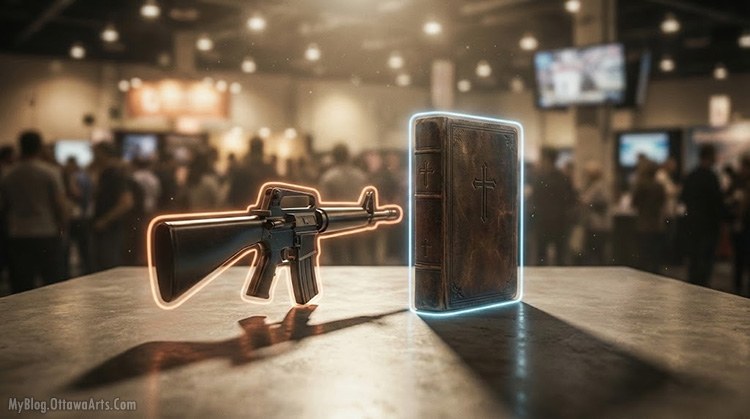
(How religious language is often deployed not to inspire humility, but to justify certainty in a chaotic world.)
There is a specific kind of silence that falls over a room when a man decides he is absolutely, terrifically, one-hundred-percent right. It isn’t the silence of peace, or the silence of understanding. It is the silence of a vacuum sealing shut. It is the sound of oxygen leaving the room because one person has decided to suck it all up into their own lungs and scream, “I HAVE THE MAP.”
I found myself thinking about this particular acoustic phenomenon last Tuesday, somewhere outside of Phoenix, standing in a convention center that smelled of floor wax, stale popcorn, and aggressive patriotism. It was a Gun and Bible show, or maybe just a Gun show where everyone happened to be quoting Leviticus, or perhaps a Revival where the collection plate accepted 9mm ammunition. The lines were blurred. The distinction was irrelevant.
Here, under the buzzing fluorescent lights—which hummed with the same insistent frequency as a bad migraine—I saw the twin pillars of the American psyche locked in a sweaty, uncomfortable embrace. On one table: a terrifyingly sleek AR-15, matte black, cold as a lizard’s eye. On the next table: leather-bound Bibles, gold-leafed, promising eternal life and the localized destruction of one’s perceived enemies.
It was a supermarket of absolutes. And God, were the customers hungry.
They weren’t looking for protection. That’s the lie we tell ourselves to make the sociology polite in its manner. They weren’t looking for salvation, either. That’s the lie the preachers tell to keep the lights on. They were shopping for the one commodity that has become more precious than lithium or fresh water in the twenty-first century: Certainty.
We are a species designed for the Savannah, optimized for running away from lions and figuring out which berries won’t turn our intestines into liquid fire. We are not designed for the twenty-four-hour news cycle, the crushing ambiguity of global economics, or the terrifying realization that nobody—absolutely nobody—is flying the plane. The cockpit is empty. The autopilot is a frantic marmot mashing buttons. And we’re all locked into a course that’s sure to see the turbulence getting much, much worse before it’s likely to get better in any meaningful and lasting sense. That is, if we can manage to avoid a nosedive into a cornfield long enough.
In the face of this cosmic absurdity, the human brain begins to overheat. It craves a binary. It wants a toggle switch. On/Off. Safe/Dangerous. Saved/Damned. Us/Them. A heavy opioid the right-wing mind especially has become addicted to: The notion that absolutely everything fits neatly into either this box or that one. There is no third box, and nothing one can think of possesses dimensions making it a difficult fit into one of the two.
Enter the Gun. Enter the God.
Now, before the hate mail starts piling up like snowdrifts in Buffalo, let me be clear. I am not talking about faith. Faith is a delicate, trembling thing; faith admits that the universe is vast and we are small and stupid. Faith is walking into the dark without a flashlight. Faith is—whether you like it or not—the human condition. We all have and need some manner of faith to some degree. If you think you don’t… well, by all means, keep having faith in that belief.
I am talking about Religion™—the industrialized, plastic-wrapped, high-fructose corn syrup version of spirituality that is currently being pumped into the veins of the body politic. This isn’t about the Nazarene carpenter who suggested we might want to be nice to each other. This is about using the Almighty as a riot shield.
The connection between the firearm and the fundamentalist dogma is not accidental. They are both technologies of finality.
Consider the bullet. It is the ultimate argument ender. It does not equivocate. It does not say, “Well, on the other hand, have you considered the socio-economic factors at play here?” No. It says BANG! That’s it. Its vocabulary is painfully limited. It resolves the tension of existence with kinetic energy. It turns a complex, breathing, nuanced problem (a person) into physics (meat). It is instant, horrible clarity.
Now consider the Dogma. It functions the same way. When the world is messy, when gender is fluid, when the economy is rigged, when the climate is rebelling against our hubris, the anxious primate brain screams for a rule. It wants a stone tablet. It wants a verse that settles the score. “God said it, I believe it, that settles it.”
Bang!
The nuance is dead. The debate is over. The anxiety is quelled. Never mind about the blood-stains left behind. We have people for that.
This is why you see the cross and the pistol bumper-stickered together on the back of so many pickup trucks. They are the same tool. They are the pacifiers for a nation that is terrified of the dark.
I watched a man at the convention center fondle a revolver with the tenderness usually reserved for a firstborn child. He was talking to the vendor about “stopping power.” He wasn’t talking about ballistics. He was talking about theology. He wanted the power to stop the chaos. He wanted the power to draw a line in the dirt and say, “Here is where the ambiguity ends.”
It’s pathetic, really. And I mean that in the classical sense. It evokes pathos. We are so scared. We are balding, soft-bellied monkeys wearing shoes we can’t afford, staring into a universe that is indifferent to our mortgages, and we are petrified. So we grab the hardest, coldest things we can find—steel and scripture—and we hold them tight, like teddy bears made of granite.
But the tragedy is not that we are scared. The tragedy is what we do with that fear.
We weaponize it.
When you possess the Truth—capital T, trademarked, unassailable—you no longer have to deal with people. You only have to deal with obstacles. If you are Certain, then the person disagreeing with you isn’t just wrong; they are Evil. They are an affront to the divine order. And you don’t compromise with Evil. You don’t listen to Evil. You exorcise it. Or, if you have enough stopping power, you neutralize it.
This is the great drug of the American zealot. Certainty is better than heroin. It calms the nerves instantly. It stops the shaking. It tells you that you are the protagonist in a cosmic war, rather than just a guy from Ohio who is worried about his cholesterol. It elevates your petty grievances into spiritual warfare.
Your neighbor isn’t just annoying because his dog barks; he is an agent of the secular decline. Your political opponent isn’t just mistaken about tax brackets; he is a demon.
This is why our discourse sounds like a knife fight in a burning asylum. We have abandoned the messy, difficult, human work of doubt. Doubt is uncomfortable. Doubt is itchy. Doubt requires you to listen, to change your mind, to admit that maybe, just maybe, you don’t know what the hell is going on.
And nobody gets elected on a platform of “I Don’t Know, Let’s Figure It Out.” Which, of course, would be the truth ninety-nine times out of one hundred.
We elect the shouters. We elect the preachers of the binary. We flock to the pundits who offer us the sweet, toxic milk of absolutes. We want the guy who says, “I alone can fix it,” because the alternative is admitting that it might not be fixable—which it very well might not be. Or, that fixing it requires us to do something more difficult than buying a new hat—which it very probably would.
I walked out of the convention center and into the blinding Arizona sun. The heat hit me like a physical blow, a reminder that nature doesn’t care about our little theological disputes. The cactus doesn’t give a shit if you’re saved or not. The rattlesnake doesn’t check your voter registration.
I lit a cigarette, mostly to give my hands something to do other than shaking a fist at the sky.
The problem with Certainty is that it is a lie. It is a map of a terrain that doesn’t exist. The map says “Here Be Dragons” and “Here Be Righteousness,” but the territory is just rocks and people and confusion and too many coffee shops and shawarma places.
The universe is fundamentally chaotic. Subatomic particles pop in and out of existence for no reason. Stars explode and wipe out civilizations that never even got the chance to invent jazz. Bad things happen to good people, and terrible people die peacefully in their sleep on high-thread-count sheets.
To look that chaos in the eye and say, “I don’t know why,” takes courage. To look at it and say, “It’s because God wants you to buy this assault rifle and vote for this specific tax cut,” takes a level of delusion that borders on the artistic.
It is a coping mechanism gone septic.
We are poisoning ourselves with clarity. We are drunk on the idea that we are right. And a drunk man with a gun—or a drunk man with a divine mandate—is the most dangerous thing on earth.
I think about the great satirists, the humanists, the people who looked at the human condition and didn’t scream, but laughed. A sad, wheezing laugh. They knew that the moment you think you have the Answer, is the moment you’ve stopped thinking.
James Thurber once wrote about a seal in the bedroom, a specter of domestic madness. We have replaced the seal with a Golden Calf, melted down from our own anxiety. We worship our own fear, disguised as strength.
Vonnegut told us that we are here on Earth to fart around, and don’t let anybody tell you different. But we can’t accept that. Farting around is terrifying. It implies a lack of purpose. It implies that we are responsible for creating our own meaning in a vacuum.
So we choose the cage. We choose the rigid structure of the Dogma and the Gun because the cage makes us feel safe. At least in a cage, you know where the walls are.
But the walls are closing in. You can feel it, can’t you? The tension in the air. The way every conversation feels like a bomb defusal. We are gripping our Certainty so tight our knuckles are white, terrified that if we let go, we’ll dissolve.
I snubbed out my cigarette on the concrete. Inside the hall, a man was likely explaining to a nodding crowd that the breakdown of society began when we stopped letting teachers hit children, or when we started letting people love who they wanted to love. He was selling them a narrative. He was selling them a pill to make the fear go away.
And they were buying it. They were buying it with the desperate eyes of street junkies.
God doesn’t need your gun. God, if It exists, probably doesn’t need your defense, your anger, or your bumper sticker. I doubt very much that God requires much of anything from you. The Infinite does not require a press agent. And, wrestle with it though I might, I’ll certainly never be able to figure out exactly what God would need with a starship.
But we do. We need starships and press passes. We need weapons and armor. Because underneath the tactical vests and the Sunday best, we are soft, shivering, frightened things, aware of our own mortality, aware that the clock is ticking, and terrified that when the music stops, we might just find that there has never been any such thing as a chair.
So we bring a gun to the party. And we tell everyone God invited us.
It would be funny, in a cosmic sense, if it weren’t so incredibly dangerous. We are standing on the edge of a cliff, arguing over who has the best map, while the ground crumbles beneath our feet.
There are no neat conclusions here. I can’t wrap this up with a bow and tell you to “choose love.” That’s hallmark card bullshit. Love is hard work. Love is messy. Love requires you to be uncertain, to be vulnerable, to be wrong.
And nobody wants to be wrong. Being wrong feels like dying.
So we choose to be Right. We choose to be certain. We choose the hard steel and the hard words. We lock the doors, load the chamber, and wait for the end of the world, smug in the knowledge that at least we saw it coming.
Whatever gets you through the night, I guess. But God help us when the morning comes.
Say… What time is it, anyway?
Further Reading:
- “How the Gun Became Integral to the Self‑Identity of Millions of Americans” — Scientific American
- “Gun culture in the United States” — Wikipedia
- “Shall not be infringed: how the NRA used religious language…” — Nature
- “America’s Complex Relationship With Guns” — Pew Research Center


