
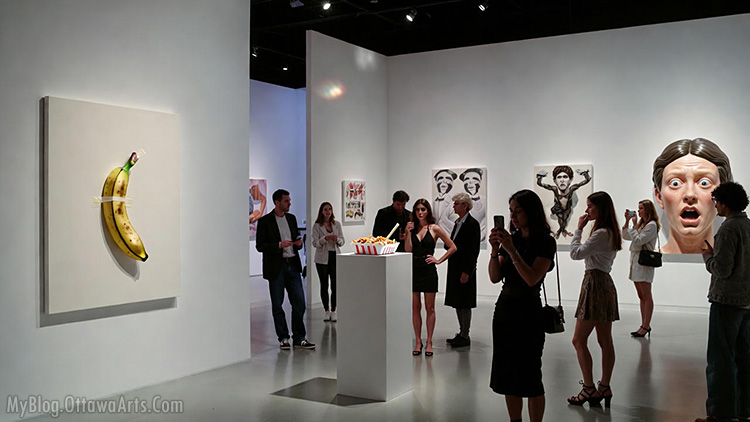
Irony, once the sly wink of the outsider, has been repackaged by galleries into a luxury accessory — a designer handbag of intellectual detachment. What began as rebellion against solemnity now hangs on white walls with price tags, curated into oblivion. The joke, once subversive, is now a commodity: irony sold by the square foot, irony framed in minimalist glass, irony explained in catalogues that cost more than rent. In the end, the art world has managed the neat trick of turning satire into status, proving that even mockery can be monetized if you add enough zeroes.
Irony, in its original incarnation, thrived in shadows, in the smoke-filled bars and late-night coffee houses of the marginally employed, the chronically disillusioned, and the people who didn’t quite fit in but somehow managed to see through the pretense of those who did. It was the currency of those who laughed while the world solemnly declared, “Hey! This is serious business, you asshole!” Irony was the lever, the catapult, the small explosion in a universe of solemnity. But somewhere between biennials, curated Instagram feeds, and the meteoric rise of postmodern capitalism’s love affair with “cleverness,” irony was ensnared, tamed, and stitched into the velvet-lined cages of galleries worldwide.
Consider the classic tableau: a white cube space with walls as sterile as a suburban dentist office. Inside, a work meant to provoke — a sculpture of a fast-food tray mounted atop a reclaimed dumpster, perhaps — is explained with placards quoting Baudrillard, Derrida, and some marketing-savvy intern who calls themselves a “conceptual translator.” The viewers nod politely, cameras poised, cognizant that they are witnessing something profound because someone told them so, yet entirely unaware that the work’s original power — its capacity to subvert — has been neutered. The joke is gone; the gallery owns it now.1
This is the ultimate coup de grâce of capitalism on satire: the reduction of rebellion to display. Irony, that sly and dangerous instrument once wielded by writers, pranksters, and occasional agitators, has become a veneer of sophistication. It has been so thoroughly commodified that its original intention is not only irrelevant but actively erased. Irony is no longer a tool for critique; it is a proof of sophistication, a badge pinned to the chests of those with disposable income and a taste for the clever. You can hang it, frame it, sell it in editions of seven, and even ship it internationally — all without anyone ever needing to understand what it was rebelling against in the first place.
In this new economy of wink-and-nod, the gallery functions less as a temple of aesthetic inquiry and more as a showroom for curated detachment. The irony is sanitized, sterilized, and packaged in a way that makes it consumable. One can almost imagine an art world board meeting where the metrics are calculated in “irony per square meter.” The consultants recommend a touch more deadpan, a sprinkle of absurdity, a dash of Dadaist gesturing — but always in ways that maximize resale value. It is the triumph of irony as a stock asset.2
The transformation is not subtle. Once, to be ironic was to position oneself outside authority, to wink at the absurdity of power structures while dodging the very real consequences of dissent. Today, irony is a social currency, an aesthetic shorthand, and in many circles, a form of signaling indistinguishable from wearing the right brand of shoes. The ironic outsider has been replaced by the ironic consumer, the one who purchases subversion in small, digestible bites. And therein lies the tragedy: the joke is no longer subversive because it is curated for consumption by the very system it was meant to critique.
Take, for example, the works of Maurizio Cattelan, the Italian prankster-artist whose pieces range from a hyper-realistic sculpture of Pope John Paul II struck by a meteor to the infamous taxidermy of a dead horse suspended in a gallery ceiling. These works, originally shocking in their humor and audacity, have become cult commodities. The same gag that once elicited outraged press coverage now appears in Instagram feeds with the caption: “Brutally witty. Must see.”3
The danger has been neutralized; the shock has been commodified.
This phenomenon extends beyond the walls of galleries and into digital spaces where the concept of “irony” has been stretched to near incoherence. Social media platforms, with their algorithmic appetites, reward ironic gestures that are easily digestible, sharable, and visually arresting. Meme culture has taken the art world’s lessons and amplified them. What was once a nuanced form of critique is now a commodity optimized for engagement: like, share, monetize. The irony is so heavily signaled that anyone with a reasonable understanding of context can see it coming a mile away. And just as in galleries, the danger lies not in overexposure but in total domestication. The system that irony once critiqued now thrives on its performance.4 We might ask, then, whether irony, when commodified, can retain any critical potency. Can a subversive gesture survive when it has been mass-produced, branded, and reframed as an asset? History suggests skepticism. Consider Marcel Duchamp, whose ready-mades once shook the foundations of artistic authority. The urinal, signed “R. Mutt,” was a mockery of high art itself. Duchamp’s gesture was a gamble, a wink at the absurdity of aesthetic pretension. Today, however, the same idea — objects presented as art — is a staple of gallery floors and auction catalogs. What was once revolutionary has been ritualized, sold, and dissected in scholarly footnotes.5
It is tempting to blame the galleries alone, but the story is more complicated. Artists themselves are complicit, often willingly. In an art world where visibility and marketability are inseparable from survival, there is an incentive to produce works that signal sophistication rather than incite revolt. The irony is curated, not chaotic; the gesture is performative, not dangerous. In this environment, subversion is measured not by its impact but by its adherence to aesthetic trends. Irony, once a weapon of the marginalized, has become a standardized feature of the mainstream.
And yet, it is in this very tension that one might detect a faint glimmer of hope — or at least amusement. The commodification of irony is, ironically, itself a kind of meta-irony. To observe the art world’s devouring of its own subversive impulses is to witness an ongoing farce, one in which the participants are both perpetrators and victims. The collectors, the curators, the critics, and the artists themselves are all trapped in a recursive loop of self-conscious cleverness. It is as if the system has turned its own critique into a spectator sport, and the spectators are paying handsomely for the privilege.
Perhaps the ultimate irony, then, is that we are still, in some perverse sense, witnessing the triumph of irony — just not in its original form. The punchline has been repackaged as a luxury good, but it remains. It exists in the tension between intent and perception, between subversion and assimilation. The gallery-goer may nod politely, the collector may frame and insure, the critic may write volumes of interpretive analysis — but somewhere, faintly, the original subversive energy persists, trapped and sparkling like a gem under glass. One could argue that Duchamp himself would have appreciated the joke: irony, once free and dangerous, is now a high-priced spectacle. The laugh is no longer ours to claim, but the joke is intact, even if we must pay admission.
It is worth noting that this phenomenon is not unique to visual art. Literature, music, and cinema have all been subjected to the same economic forces. The ironic protagonist in contemporary fiction is often more a brand than a character, a vessel for signals of taste rather than a vehicle for critique. Satirical television shows operate under the gaze of advertisers and shareholders, packaging subversion in fifteen-minute increments. Even stand-up comedy — that hallowed forum of social critique — has become a medium in which irony is measured not by its audacity but by its algorithmic shareability. Across cultural media, the pattern is consistent: the systems that once inspired critique now thrive on it.
So what, if anything, can be done to reclaim irony’s original potency? Some suggest that irony must retreat, hide, mutate into forms impervious to commodification. Perhaps it will flourish in underground spaces, in ephemeral gestures, in the transient and the anonymous. Or perhaps it will evolve into a form of critique so nuanced that it becomes invisible to the mechanisms of capitalization. The stakes are high because irony is more than a stylistic choice: it is a way of seeing, a lens that allows one to perceive absurdities, contradictions, and hypocrisies with clarity and humor. When irony dies, in its original, uncommodified sense, so too dies a vital instrument of critical thought.
Yet, despite the commercialization, the human hunger for subversive laughter persists. Artists, writers, and pranksters continue to devise gestures that resist easy categorization, moments that elude capture by auction houses or Instagram feeds. In these acts, irony survives as a living force — mischievous, slippery, and alive. And perhaps this is the final lesson: the death of irony in galleries does not signal its absolute demise. It merely reminds us that irony is most potent when it exists at the edges, in spaces unsanctioned by commerce, in the cracks of a world that otherwise demands seriousness.
In the end, the art world has taught us a paradoxical truth: irony can be commodified, repackaged, and sold, but it can never be fully killed. Its spirit persists in the wink behind the placard, the smirk at the auction, the silent chuckle at a work of rare genius that refuses to conform. Galleries may frame it, collectors may insure it, and critics may canonize it, but irony — the sly, dangerous, exhilarating irony — will always find a way to bite back… hopefully.
And perhaps, in that struggle between commodification and subversion, we glimpse the enduring magic of art itself: the capacity to surprise, to unsettle, and to remind us that the world is not as serious as it insists we believe. In the sterile white cubes, irony may be boxed, catalogued, and priced, but outside, in the alleys, the bars, and the secret corners of the imagination, it remains untamed. And that, after all, is where its true power resides.
Footnotes:
- A notable example is Banksy’s “Girl with Balloon,” which has been reproduced as prints and exhibited in galleries with explanatory signage, transforming street subversion into gallery commodity.1 ↩︎
- See the 2018 Frieze London fair, where ironic installations were sold for millions, their subversive intent secondary to marketability. ↩︎
- Maurizio Cattelan’s “Comedian,” a banana duct-taped to a wall, sold for $120,000 at Art Basel 2019 — literally turning absurdity into currency. ↩︎
- Meme culture mirrors gallery commodification: ironic detachment is quantified in likes and shares rather than impact or insight. ↩︎
- Duchamp’s ready-mades, once scandalous, are now displayed in the Museum of Modern Art, their shock value absorbed into institutional legitimacy. ↩︎


