
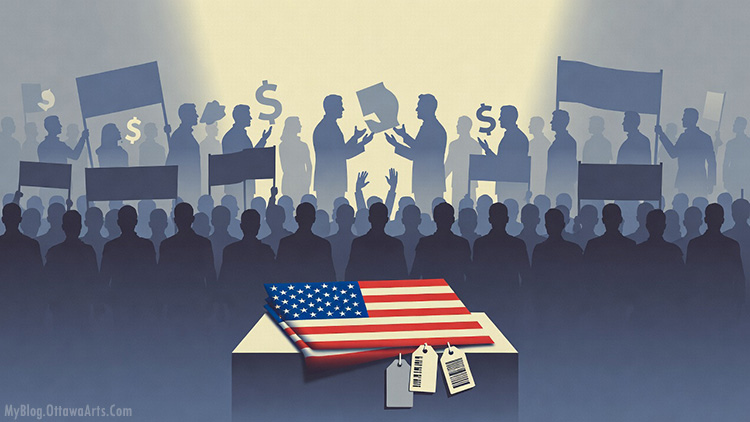
The Cult of the Flag
There’s a man in Ohio wearing a hat that cost him $34.99 who believes he owns America.
Not shares it. Not participates in it. Owns it. The hat told him so. It came with a slogan—something about greatness, something about again—and the slogan came with a feeling, which is the only product that matters anymore. The feeling costs extra. You pay for it in cognitive dissonance, mostly. Sometimes in relationships. Often in the vague, gnawing suspicion that you’ve been had, but you’re in too deep to admit it now, so you buy another hat.
Welcome to the modern nationalist marketplace, where countries are no longer geographical entities with complex histories and even more complex futures, but brands. And like all successful brands, they don’t sell you a product—they sell you an identity you can wear to the grocery store.
This isn’t your grandfather’s nationalism. That version required land grabs, conscription, maybe a catchy anthem written by someone who could actually read music. Modern nationalism requires none of that tedious state-building nonsense. It requires a logo. A color scheme. A three-word slogan simple enough to fit on a bumper sticker and vague enough to mean absolutely nothing and therefore everything.
The thesis here—if we’re going to pretend this has the structure of an argument and not just a scream into the void—is this: Right-wing nationalism in the 21st century functions primarily as emotional branding for populations who’ve confused anxiety with analysis. It’s not a political philosophy. It’s a lifestyle choice. It’s Peloton for people who think stationary bikes are for coastal elites.
And it’s working. Spectacularly. Horrifyingly. With the kind of success that makes you wonder if maybe humanity peaked somewhere around the invention of antibiotics and it’s been diminishing returns ever since.
Nationalism, Now With Better Marketing
Let’s get definitional for a moment, because words still mean things, even if we’ve collectively decided they’re negotiable.
Old nationalism—the kind that built nation-states and occasionally required reading—was about consolidating power, establishing borders, creating institutions, standardizing language, forging collective identity through shared trauma (usually a war, sometimes a famine, occasionally both). It was ugly, often brutal, frequently genocidal, but it was at least coherent. It had a purpose beyond making people feel important at barbecues.
Modern nationalism? It’s a fucking baseball cap.
It’s a flag emoji in a Twitter bio. It’s a yard sign that says something aggressive about standing for the anthem, as if the primary threat to your community is people with bad posture during sporting events. It’s an entire political identity that can be communicated through merchandise, which is convenient because thinking is hard and shopping is easy.
The shift is profound. We’ve moved from nationalism as state-building project to nationalism as aesthetic choice. You don’t need to understand trade policy or constitutional law or the complicated history of ethnic conflict in your region. You just need to feel things. Preferably angry things. Directed at people who don’t look like you or talk like you or shop at the same stores you do.
The beauty—and I’m using that word the way a coroner uses it—is the simplicity. Complex global supply chains that make your cheap t-shirt possible? Forget it. Just know that foreigners are stealing your jobs, even though you don’t want those jobs and the jobs that were stolen were actually automated or moved by the same corporations whose flags you’re waving. Details are for academics. You’ve got a country to save. From what? Shut up. Buy the hat.
This is toddler-level narrative construction applied to adult anxieties. And it works because toddlers aren’t stupid—they’re efficient. They understand that crying gets results. That simple explanations are emotionally satisfying even when they’re factually worthless. That belonging to a group feels better than understanding why the group exists in the first place.
Right-wing nationalism has figured out what every successful brand knows: people don’t buy products, they buy feelings. And the feeling they’re selling is certainty. The certainty that you matter. That your country matters. That mattering means someone else doesn’t. That this equation adds up to something other than existential emptiness with better merchandising.
Borders as Comfort Objects
Let me tell you about borders, those magical fucking lines that somehow explain everything wrong with your life.
You’re broke? Borders aren’t strong enough. Healthcare system collapsing? Borders. Schools failing? Borders. Marriage falling apart because you spend six hours a day screaming at strangers on the internet about the decline of Western civilization? Definitely borders.
The modern nationalist relationship with borders is indistinguishable from a toddler’s relationship with a security blanket. It’s an object that provides emotional regulation in the absence of actual understanding. And like all comfort objects, its power is entirely psychological. The blanket doesn’t actually protect you from monsters. The border doesn’t actually protect you from the chaos of global capitalism, technological disruption, climate change, or the simple, grinding reality that you’re a temporary arrangement of carbon briefly aware of its own existence and no amount of sovereignty is going to change that.
But here’s the thing about psychological comfort: it doesn’t need to be real to be effective. The person who’s never left their county becomes deeply invested in national sovereignty. The guy who hasn’t crossed state lines in a decade is suddenly an expert on immigration policy. The woman whose only interaction with foreigners is arguing with bots on Facebook somehow knows exactly how borders should be enforced, monitored, militarized, worshipped.
This would be funny if it weren’t so fucking predictable.
Borders, in the nationalist imagination, are where control lives. They’re the place where you can finally say “no.” Where complexity stops and simplicity begins. Where “us” gets defined by the act of excluding “them.” Never mind that the actual border is a bureaucratic fiction maintained by the same governmental apparatus you claim to distrust. Never mind that everything you own was made somewhere else by someone else who crossed some other border that didn’t stop them because capital doesn’t care about your feelings. Never mind that the border has never, not once, actually delivered the security it promises.
What matters is the story. The story says: there was a time when things made sense. When borders were strong and communities were cohesive and people knew their place and everything worked according to a natural order that has definitely always existed and isn’t just a nostalgic hallucination based on selective memory and deliberate historical ignorance.
The story says: we can get back there. We just need to make the borders stronger. Higher. More. Borders as solution. Borders as identity. Borders as proof that you still matter in a world that has moved on without asking your permission.
It’s a children’s story. And like all children’s stories, it requires believing in magic. The magic that lines on a map can restore dignity. That sovereignty and prosperity are the same thing. That complexity can be solved by simply saying “no” louder.
The Myth of the “Real People”
Every nationalist movement requires an origin myth, and the modern right-wing version goes like this: There exists a category of humans called “Real People.”
These Real People—always capitalized in the imagination, always singular in their wants—are salt of the earth types. They work hard. They love their families. They respect tradition. They don’t complain. They don’t ask for handouts. They don’t have complicated opinions about gender or uncomfortable questions about history. They just want to be left alone to do Real People things in peace.
And they’re being destroyed. By immigrants. By elites. By academics. By the media. By change itself. The Real People are under siege, and only nationalism—the right kind of nationalism, the kind you can buy on a website that also sells tactical gear and survival seeds—can save them.
Here’s the problem: the Real People don’t exist.
They’re a rhetorical invention. A political fiction designed to do one thing: draw a circle around “us” by defining “them.” The Real People aren’t an actual demographic—they’re whoever the speaker needs them to be at any given moment to justify whatever exclusion is currently popular.
Rural farmers? Sure. Unless they’re migrant workers, in which case they’re not real enough. Working class? Absolutely. Unless they’re unionized or black or demanding healthcare, in which case they’re corrupted by outside agitation. Traditional values? Of course. Unless those traditions include any culture that isn’t white European, in which case they’re primitive.
The definition shifts. The category flexes. But the function remains constant: to create a mythical core population whose interests are presumed to be singular, obvious, and under threat. A population that can only be protected by strong borders, strong leaders, and the expulsion of everyone who doesn’t fit the current definition of Real.
This is circular logic as political strategy. Belonging is defined by exclusion. Identity is constructed through opposition. You know who you are by knowing who you’re not. And nationalism—the modern, branded, merchandised version—exists to enforce that distinction with the moral clarity of a child sorting toys.
The genius is in the ambiguity. The Real People are whoever you need them to be. They’re you. They’re your neighbors. They’re some imagined community of folks who think like you and vote like you and hate like you, and together you constitute the true heart of the nation, which is currently being murdered by people who don’t understand what made it great in the first place.
Never mind that internal diversity is the actual story of every nation that’s ever existed. Never mind that the traditions being defended are often recent inventions. Never mind that the enemies change but the anxiety remains constant. What matters is the feeling. The feeling that you belong. That your country is yours. That someone is trying to take it away.
And that feeling requires an enemy. Always. Because without an enemy, the category dissolves. Without “them,” there is no “us.” Without threat, there is no unity. Without exclusion, the whole fucking edifice collapses into what it always was: a way to manage your fear of irrelevance by convincing yourself that your anxieties are actually a political movement.
Nationalism’s Global Irony Problem
Here’s where it gets beautifully, cosmically absurd.
Nationalist movements around the world—each claiming to represent the unique, irreplaceable character of their specific nation—are reading from the exact same script.
Same slogans. Same enemies. Same aesthetics. Same talking points. Same funding networks. Same social media strategies. Same conspiracy theories about globalists and elites and the Great Replacement and cultural Marxism and whatever other paranoid fantasy is trending this quarter.
You’ve got MAGA in America. National Rally in France. AfD in Germany. Fidesz in Hungary. PiS in Poland. League in Italy. Vox in Spain. They all hate globalism. They all warn about immigration. They all promise to restore greatness. They all position themselves as defenders of tradition against cosmopolitan elites who want to erase national identity.
And they all sound exactly the fucking same.
This isn’t coincidence. This is coordination. Or at minimum, convergent evolution in an ecosystem that rewards identical survival strategies. They share funders. They share conferences. They share consultants. Steve Bannon didn’t just stay in America—he went international, selling the same populist playbook to anyone willing to buy. The same think tanks that push nationalism in one country export the model to the next. The same online networks that radicalize young men in Ohio are doing it in Yorkshire and Bavaria and Warsaw.
So here’s the pitch: your nation is unique. Your culture is precious. Your identity cannot be diluted. Your sovereignty cannot be compromised.
And to protect all of that uniqueness, you should… adopt the exact same politics as every other nationalist movement on earth?
The irony is structural. The movements that claim to defend cultural particularity are themselves proof of cultural homogenization. They’re McDonalds franchises complaining about globalization. They’re Starbucks yelling about local authenticity. They’re the ideological equivalent of suburban housing developments: identical boxes convinced of their own individuality.
This doesn’t weaken the movements. If anything, it strengthens them. Because the point was never actually about preserving unique national character. The point was about belonging to something bigger than yourself. About finding community. About having enemies. About the emotional satisfaction of simple answers to complex questions.
And that formula works everywhere. Because anxiety is universal. Decline is relative. And the need to believe that your suffering has a villain is as old as consciousness itself.
Who Profits From This Fantasy?
Follow the money. Always follow the money. Because while the foot soldiers of nationalism are out there defending the homeland from imaginary invasions, someone’s getting rich.
Not you, obviously. You’re buying the hats.
But the people selling the hats? They’re doing fine. So are the politicians who discovered that stoking ethnic resentment is cheaper than developing actual policy. So are the media personalities who built empires by telling angry people that their anger is actually patriotism. So are the consultants who package rage into electoral strategy and sell it to whichever party is willing to abandon any remaining pretense of giving a shit about governance.
Nationalism, in its modern form, is a profit center. A business model. A way to monetize anxiety and call it activism.
Consider the ecosystem:
- Politicians who need votes but lack ideas use nationalism to short-circuit the entire policy formation process. Why develop a healthcare plan when you can just promise to keep foreigners out?
- Media companies that need engagement discovered that nationalism is a content goldmine. Every immigrant is a story. Every cultural shift is a threat. Every demographic change is an invasion. The clicks write themselves.
- Merchandisers of grievance sell you flags and shirts and coffee mugs and commemorative coins that prove you’re a patriot, which is apparently something that needs proving through consumer purchases now.
- Online platforms that profit from engagement boost nationalist content because nothing keeps people scrolling like rage, and nothing generates rage like the suggestion that your country is being stolen.
The beauty of the con—and it is a con—is that it concentrates power upward while redirecting anger downward.
The politician who slashes your healthcare and guts your schools and ships your job overseas isn’t your enemy. The immigrant who also got fucked by that same politician is your enemy. The system that created the precarity you’re drowning in isn’t the problem. The people even more precarious than you are the problem.
This is the oldest trick in the book. Bread and circuses. Divide and conquer. Give them someone to hate so they don’t notice who’s robbing them. Nationalism is just the current iteration. The branding is modern, but the mechanism is ancient.
And it works because the people profiting from it understand something crucial: you don’t have to deliver actual results. You just have to deliver the feeling of resistance. The sense that you’re fighting. That you’re not just taking it. That you’re standing up for something, even if that something is a fantasy sold to you by people who wouldn’t piss on you if you were on fire.
The nationalist project promises you control. What it delivers is a steady transfer of wealth and power to people who already have an abundance of both. You get the flag. They get everything else.
The Cost: What Nationalism Destroys Quietly
The thing about nationalist movements is that they don’t usually end with jackboots and book burnings. Not immediately. Not obviously.
They end with erosion. With slow collapse. With institutions that stop functioning because they’ve been delegitimized so thoroughly that nobody believes in them anymore. With trust that dissolves because every interaction is now tribal. With cooperation that becomes impossible because the other side isn’t just wrong, they’re “enemies of the people™”.
Democracy doesn’t die with a bang. It dies with a thousand small cuts. And nationalism is very good at cutting.
It cuts civil trust. When your political identity is based on the idea that half the country is trying to destroy the nation, you can’t exactly work together on infrastructure. You can’t compromise on policy. You can’t even agree on basic facts, because facts themselves become tribal markers.
It cuts institutions. Courts are legitimate only when they rule your way. Elections are valid only when you win. The media is credible only when it confirms your beliefs. The very structures that make collective governance possible are dismantled piece by piece, brick by brick, all in the name of defending the nation from those who would… uh… defend it differently.
It cuts international cooperation. Climate change doesn’t care about borders. Pandemics don’t respect sovereignty. Economic systems are global whether you like it or not. But nationalism demands that every problem has a national solution, which is fucking great when the problems are actually transnational and require the kind of multilateral cooperation that nationalism categorically rejects.
The damage accumulates. It’s not dramatic. There’s no single moment where everything breaks. Just a gradual decline. A slow-motion collapse. Democratic backsliding. Authoritarian creep. The normalization of political violence. The acceptance of corruption as long as it’s your corruption. The redefining of loyalty from “adherence to shared principles” to “obedience to shared hatreds.”
This is the bill that comes due. And it comes due slowly enough that you can pretend it’s not happening. That you can tell yourself things are fine, actually, better than fine, we’re winning, we’re standing up, we’re fighting back, we’re making the country great again.
Right up until the moment you realize that the country you thought you were saving doesn’t exist anymore. That it was replaced—slowly, incrementally, irreversibly—by something uglier and meaner and stupider. Something that might wave the same flag but has forgotten why the flag mattered in the first place.
Why It Keeps Working (Even When It Fails)
The frustrating thing—the absolutely maddening thing—is that nationalism keeps working even when it demonstrably fails.
Brexit didn’t deliver prosperity. It delivered supply chain chaos and economic contraction. Trump didn’t drain the swamp. He restocked it with different alligators. Fidesz didn’t restore Hungarian greatness. It installed authoritarian rule and got rich doing it.
And none of it matters.
Because nationalism isn’t selling results. It’s selling emotions. And emotions don’t require evidence. They require validation.
You feel anxious? Nationalism says your anxiety is justified. You feel left behind? Nationalism says you’re being deliberately marginalized. You feel like the world is changing too fast? Nationalism says change is attack and resistance is virtue.
This is emotional efficiency. Simple villains. Simple solutions. Simple identities.
The immigrant is why you’re poor. Not the CEO who automated your job and moved production overseas. The immigrant—who actually has less money and less power than you do.
The elite is why you’re ignored. Not the political system that’s been captured by corporate interests. The elite. The cosmopolitan. The rootless. The other.
Complexity is hard. Nuance is exhausting. Structural analysis requires work. Nationalism offers none of those things. It offers a story. A story where you’re the hero. Where your suffering has meaning. Where your anger has a target.
And that story is so emotionally satisfying that factual rebuttals bounce off like rain on concrete. You can show them the data. You can explain the economics. You can trace the historical precedents. You can demonstrate, exhaustively, that nationalism has never delivered what it promises.
And they’ll nod. And they’ll say “yeah, but it feels right.”
Because it does. That’s the fucking problem. It feels right. It feels true. It feels like the kind of simple, clear, obvious explanation that makes sense in a world that mostly doesn’t. It offers the kinds of explanations and potential solutions you could have easily wrapped your head around when you were ten years old.
Nationalism is an addiction. And like all addictions, it works by hijacking your reward system. The high is the feeling of belonging. Of purpose. Of righteousness. And the comedown is the realization that you’ve been had, which is why you never come down. You just get another hit. Another rally. Another enemy. Another reason to believe that this time, THIS time, if we just make the borders strong enough and the identity pure enough and the enemies clear enough, everything will finally make sense.
It won’t. It never does. But addiction doesn’t run on results. It runs on need.
And the need is real. The anxiety is real. The feeling of powerlessness is real. Nationalism offers a solution that isn’t actually a solution, but it feels like one, and feeling is the only currency that matters anymore.
A Country Is Not a Personality
Here’s what they won’t tell you, the people selling you nationalism like it’s a cure for existential dread: a country is not a personality.
It’s not an identity. It’s not a substitute for having an actual interior life. It’s not a character trait. It’s not who you are.
A country is a bureaucratic entity. A collection of institutions, laws, competing interests, historical accidents, and people who mostly don’t agree on anything except that they happen to be governed by the same administrative apparatus. That’s it. That’s the romance.
But modern nationalism requires you to believe otherwise. It requires you to believe that the nation is a living thing. That it has a soul. That it can be betrayed. That it requires your devotion. That you can own it, defend it, restore it to greatness through the simple act of hating the right people and buying the right merchandise.
This is a child’s understanding of collective identity. And we’ve built an entire political movement around it.
The man in Ohio with the $34.99 hat doesn’t own America. He doesn’t even own the hat—it was made in China by someone who has their own set of nationalist idiots to deal with. He owns a feeling. The feeling that he matters. That his anxiety is politics. That his fear is patriotism.
And maybe that’s enough for him. Maybe the feeling is worth it. Worth the lie. Worth the erosion. Worth the quiet collapse of every institution that might actually improve his life.
But it’s not enough for a country. Countries need more than feelings. They need boring shit. Infrastructure. Compromise. Functional governance. The kind of tedious, unsexy work that doesn’t fit into a slogan that can be printed on a hat.
Nationalism offers none of that. It offers spectacle. Identity. The emotional satisfaction of knowing who the enemy is. And that satisfaction is poison. Slow poison. The kind that feels like medicine right up until you realize you’re dying.
So here we are. A world full of people convinced they’re defending their nations by destroying the civic foundations that make nations possible. Flying flags. Wearing hats. Shouting slogans. Feeling things. Feeling so many things. Just not the things that might actually require them to do something other than hate and buy and belong.
The country you think you own is owned by someone else. Always has been. And they’re laughing all the way to the bank while you argue about borders.
But hey. At least you got a snazzy hat out of the deal.
Further Reading:
- Stanford Encyclopedia of Philosophy — Nationalism (Spring 2024 Edition) — In‑depth, peer‑reviewed philosophical overview of nationalism and its modern variants, including populism connections.
- Imagined Communities (Wikipedia) — Overview of Benedict Anderson’s foundational concept explaining how nations are socially “imagined,” a key idea in nationalism studies.
- National Populism: The Revolt Against Liberal Democracy (Wikipedia) — Analysis of the rise and appeal of national populist movements that align with modern nationalist branding.
- The Origins, Characteristics and Trends of Neo‑nationalism in the 21st Century (Open Access) — Scholarly article on modern forms of nationalism distinct from traditional models.
- Nationalism, Populism, and Fear (WCSA Global Journal) — Academic essay on how nationalism and populism mobilize voters and shape contemporary politics.


