
How Cafés, Bookshops, and Bars Keep Cities Human
In the churning metabolism of modern cities—those restless beasts of glass, steel, and algorithm—there exist small, flickering sanctuaries that refuse to vanish. They are the cafés, bookshops, and bars where people still gather not because they must, but because something in their nature aches for the proximity of others. The sociologists once called them “third places,” a tidy term for the messy business of being human. Home is the first place, work the second, but this—this humble in-between—is where civilization remembers itself.
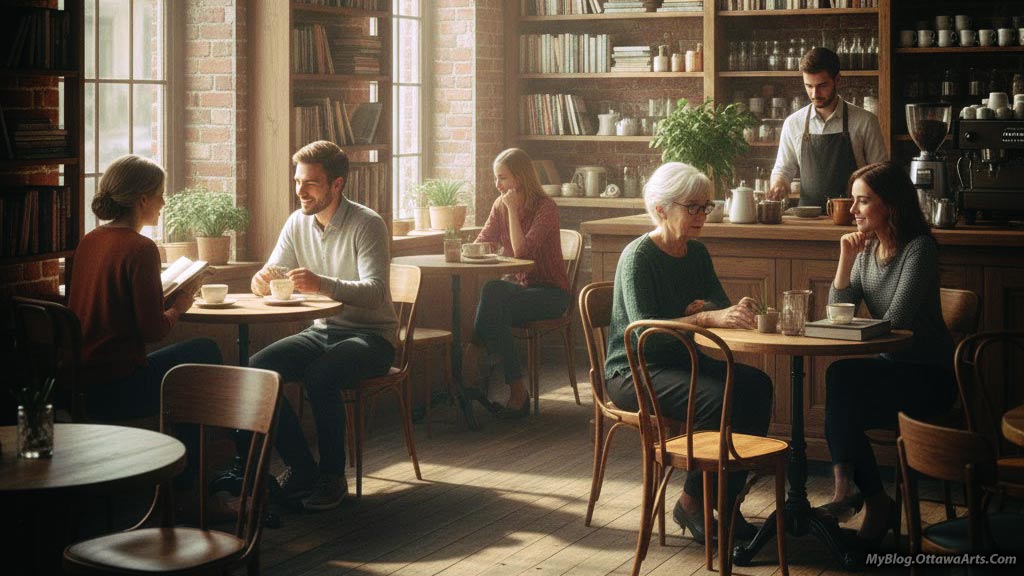
You can feel their pulse if you walk the downtown streets on a gray Wednesday morning. The coffeehouse breathes like a lung. A man in a threadbare coat writes letters no one will ever answer. A pair of students murmur over laptops, their earbuds dangling like antennae into another world. The barista, in a mood of easy melancholy, wipes the counter with a rag that’s seen too much of just about everything. And yet something persists here—a fragile social electricity, the hum of unarranged conversation. The city, for a moment, feels like a single, beating heart.
Ray Oldenburg, the urban sociologist who coined the phrase third place in the 1980s, argued that these informal public spaces are the foundations of democracy. It was in taverns, not parliaments, that revolutions were conceived; in cafés, not boardrooms, that philosophies found their wings. The agora of Athens, the Parisian café, the smoky American diner—each was an oxygen tank for civic life. When those spaces disappear, the argument goes, so too does the chance encounter, the serendipitous spark that keeps a society awake.
Yet today, the very idea of communal presence feels antiquated, like a rotary phone or a handwritten letter. The pandemic accelerated the retreat; our screens promised safety and efficiency, and we accepted the bargain with a shrug. Meetings became squares of light. Friendships became emojis. The casual chatter that once spilled across tabletops was filtered into the sterile language of group chats. Third places—those social laboratories of empathy—were shuttered, first temporarily, then permanently, as landlords and logistics claimed their rent.
And still, somehow, some manage to resist extinction. There’s a stubborn grace to them, a low-burning revolt against the digital void. Walk into any surviving café—Ottawa, Montreal, New York, doesn’t matter—and you’ll sense it: the hum of espresso machines and the low murmur of people choosing to be physically near one another. No app can replicate that sound, that scent of roasted coffee mingled with rain on the pavement, the small miracle of overheard laughter from a table of strangers. It’s analog intimacy, and it matters. Somewhere, deep down, most of know it does.
Sociologists will tell you that third places are engines of “social capital.” But that phrase, clinical and dry, misses the poetry. What they build isn’t capital—it’s communion. They offer permission to linger, to be nobody in particular. You can drift in, unannounced, and find yourself drawn into conversation with a bookseller, a poet, a cab driver. For a brief and sacred interval, status dissolves. Everyone is simply a citizen of the room. In an age that measures everything, this kind of immeasurable connection feels radical.
The café, after all, is democracy’s secret church. Its rituals are modest—the ordering of a drink, the finding of a seat—but the faith is profound: that people, when placed near one another without agenda, might create something finer than commerce or efficiency. There’s a reason revolutions so often begin over coffee. The mind quickens in the company of others. Ideas ferment in steam and noise.
Yet landlords and algorithms share a grim consensus: the margins are too thin. Independent cafés are squeezed by chains; bookshops vanish under the weight of one-click convenience. Even the neighborhood bar, once a fixture of working-class mythology, struggles against the rising tide of isolation and sobriety. What’s lost is more than ambience—it’s the muscle memory of community. When you remove the spaces where strangers once met, the city becomes a geography of sealed silences.
There are new third places, of course—co-working hubs with artisanal lighting, virtual chatrooms where avatars sip pixelated drinks. But they lack the accidental, the awkward, the gloriously human disorder that gave the old spaces their soul. In the café, you could be interrupted, overheard, delighted, or annoyed. Online, the algorithm spares you that risk, curating a world of agreeable sameness. Safety at the cost of surprise.
Still, there are those who resist the sterility. Independent bookshops are staging a small renaissance, buoyed by nostalgia and the quiet defiance of readers who crave the tactile. The corner bar rebrands itself as a “community hub,” offering open-mic nights and local art. The coffeehouse doubles as a co-op, a miniature commons where artisans and dreamers exchange currency in conversation. These are not relics; they are prototypes for survival. They remind us that culture, at its most basic, is an act of gathering.
On a recent afternoon in the Glebe, I watched as an elderly man spilled his coffee. The young woman beside him—her face half-buried in a laptop—looked up, smiled, and offered him a napkin. He thanked her; she laughed; they spoke for a few minutes about nothing in particular. It was a small, forgettable moment, the kind that never trends, never monetizes. Yet there it was: civilization, unfolding quietly over a cup of coffee.
The future may yet belong to those who understand the necessity of such moments. We are creatures of narrative, yes, but also of proximity. When we lose our third places, we lose the rehearsal space for empathy—the practice field of democracy. The hum of a café, the cluttered shelves of a bookshop, the low light of a bar at dusk—these are not luxuries. They are infrastructure for the human spirit.
If cities are machines for living, then third places are their souls: improvised, imperfect, endlessly social. In their persistence lies a quiet revolution, one fought not with slogans or manifestos, but with conversation, with eye contact, with the unassuming heroism of simply showing up. Civilization may run on silicon and data now, but its heartbeat, still, is measured in the sound of a door chime and the smell of coffee just beginning to burn.


